
Abstract
This extended writing examines the enduring role of artistic expression as a fundamental outlet of the human consciousness, centralising this study on the works of Francisco Goya. The following research explores both the complexity and versatility of Goya’s artistic contributions, as well as examining the circumstances of his broader livelihood, of which influenced him to create such works. By situating Goya’s artworks within its historical and philosophical contexts, this wider analysis underscores in what ways art is able to bridge individual thought, with external realities. Through Goya’s legacy, and his influence on subsequent creators, this study demonstrates the transformative power of art to offer collective understanding, provoke reflection, and navigate the ongoing dialogue of what it means to be human. Consequently, this raises broader questions about humanity’s cyclical nature—its tendencies toward conflict and destruction—and its capacity, or lack thereof, for moral progress.
Introduction
Creative expression, in its broadest capacity, serves as arguably one of the most primal and profound forms of human communication; a mechanism by which we collectively process, respond to, and make sense of the complexities that are inherent in human existence. It is through acts of creation, that we, as a collective, seek to derive meaning from our very existence. This writing intends to explore art in its essence as a deeply ingrained aspect of humanity, and ultimately, in what ways we utilise this medium as a testament of what it truly means to be alive. As humankind evolves, art complements such development. I intend to outline visual communication as an extension of the conscious mind—emphasising the sheer potential of creative output as a uniting and formidable force of man.
Alongside this, this dissertation situates Spanish artist, Francisco Goya as a primary case study to investigate the means of creative output serving as both an introspective reflection of self and a universally resonant symbol of mankind. I will focus on a wider discussion surrounding the circumstances in which Goya lived, outlining particular religious upheaval, institutional dominance, and warfare, whilst contrasting with more personal forms of turmoil. This will be examined through a selection of key artworks that exemplify these pivotal moments, and how he articulated his own endeavours through his incredibly complex, yet turbulent life. Through this, I intend to exemplify Goya’s confrontational quality within his work; his ability to address the landscape of his expansive life, whilst grappling with his own internal uncertainties towards the penultimate years of his life. Why are the works of Goya so striking to begin with? Why is it important to engage with history through artistic means?
Further, I aim to investigate the enduring legacy of the artist, with the latter portion of the writing shifting focus toward Pablo Picasso, a symbol of contemporary Spanish relevance, whose practice engages with similar themes of human resilience, and the cyclical nature of history. This will be articulated through a particular political example, akin to Goya, produced within a period of warfare, investigating what ways our moral failings have been overlooked, and perpetuated throughout human history. It is through addressing these recurring patterns, that this wider analysis aims to highlight the incessant role of art in challenging such deep-rooted behaviours, provoke urgency, and reflect upon such destructive dispositions—questioning why we have neglected to confront uncomfortable truths of the past. This extended writing focuses predominantly on the artistic contributions and existing legacy of Goya as a primary focus, while acknowledging the limitations of this writing specifically. There is an apparent lack of female representation within this particular context. This omission is not intended to diminish or even entirely disregard the significant contributions of women within the broader notion of art history, but rather this writing is intended to communicate a focused study in which the works of Goya are scrutinised as a vessel for contemplation. An attempt to artificially create division within this narrative would undermine the universal message of art as a collective human endeavour—a message that so happens that Goya’s work resonates with so profoundly.
The Human Conscious
Art, in its purest form, is an inherent response to life; a manifestation of humanity’s fundamental drive to create perceived purpose and reason from lived experience. Within the broader scope of human evolution, the act of creation itself endures as a profound testament to what it truly means to be alive—an endeavour to comprehend the external world, confront the magnitude of human consciousness, and ultimately endure as a collective. The universal human desire for meaning, alongside the pursuit of better understanding the complexities of existence, inherently finds influence through artistic output. As aptly noted, it is by nature that art can be interpreted as ‘a specific type of cognitive engineering’, marked as a central component of the human experience (Turner, 2006). In tandem with this, Turner contends that ‘the artistic object compels (a) reflection on the very process that created it […] on the mind of the artist, and thus the society from which the artist emerged’, (2006: 5). The very nature of storytelling through visual means transcends the proposed limitations of verbal language, which as a result offers an elevated universal quality in order to unite humanity; ultimately viewing wider art as ‘an area in which humans naturally participate’ merely offered as a documentation of human history (Gardner, 1973).
Within this context, art is presented as a fundamental, primal response to human existence, ‘brought to pass by means of human activity’, (Hegel, 1997). This can be argued as an essential mechanism by which humans process, and hence respond to the external world, and ultimately, their place within it. In this regard, creative output holds the capacity to function as an evolutionary chronicle of struggles, triumphs, and the relentless pursuit to derive meaning amid moments of uncertainty.
Following the ever-evolving landscape of visual works, a plethora of artistic revelations have persevered throughout history, serving as a sincere yet practical archive of ‘society’s collective memory, preserving what fact-based historical records may not be able to’ (Darda and Cross, 2022). Complementing this, the prevailing notion that ‘art history is human history’ (Tomlinson, 2021), also suggests that art is far from an isolated aesthetic endeavour, but alternatively, a means by which mankind can express the vulnerabilities of the human condition. Throughout the wider historical discourse, artistic pursuits arose as instinctive reactions from an assimilation of the cultural, political, and religious climates within a given historical context, and through this, ‘(have) remained a consistent practice for centuries’, (Meyer, 2024). Creative pursuits have undeniably shifted alongside the progressive evolution of humankind, wielding ‘creative output’ to accommodate continuously shifting priorities. A statement attributed to Dissanayake, ‘core human nature (has) evolved to require aesthetic and spiritual satisfactions […] humans as a species do not live by bread alone’, (1992, 3). Early artworks predominantly fulfilled ceremonial or devotional functions, designed to ‘decorate utilitarian objects, demonstrate social status, and highly religious depictions’ (Master’s Gaze, 2023).
However, the ‘advent of free thought’ (TED-Ed, 2014), marked a pivotal shift in artistic practice. Art began to break away from the confines of religious orthodoxy and ceremonial obligations, but instead, transitioning toward introspective explorations of human existence. This transition enabled creators to imbue their works with incredibly personal subject matter, fostering a newfound sense of emotional catharsis as a means of confronting and communicating internal anxieties. At its very core, art fulfils essential human requirements. ‘Art is the means by which life reflects on, transforms and indeed creates its values; human life without it would not properly be human at all’ (Hickman, 2005). As society continues to evolve, the purpose of art shifts alongside it; accommodating the new priorities of man, while retaining its role as a conduit for both emotional expression and cultural reflection. Is the power of art found in its objective accuracy, or in its capacity to convey subjective truths?
Within this broader context, Francisco Goya (see Figure 1) emerges as a pivotal figure within the study of art. Celebrated for his unparalleled artistic aptitude, and critically renowned for his exceptional ability not only highlighting his technical proficiency, but his ability to grapple with the intricacies of the human condition in its vastness; all through the confines of visual media. Despite the centuries that separate his defining era from the present day, Goya’s legacy, and paramount contributions to the contemporary landscape of ‘art’, are to be noted that ‘(he) remains extraordinarily compelling today’ (Symmons, 1998) and continues to resonate; addressing his capacity to so viscerally delineate the intensity of being human. It is to be noted that Goya, born in 1746, is widely appraised as a luminary within the sphere of art during the latter years of the 18th and early 19th centuries. His remarkable union of both printing and painting techniques is recognised as ‘the pinnacle of his technical and creative achievement as an artist’ (Genocchio, 2008). Notably, Goya, an artist ‘devoted to expressive liberty’ (Fesisati and Sperati, 2010) is esteemed as a Romantic painter, whose work is characterised by the raw, untempered emotion detailed within his subject matter. Goya’s ability to distil his own lived experiences, allows for a more comprehensive understanding of the ‘complex concepts and ideas that might be difficult to grasp through other means’, (Garcia, 2023). Alongside this, Goya employs the wider ‘concept’ of catharsis within his artworks, a term attributed to that of Aristotle (Fyfe, 1932), as a pivotal mechanism within his artistic practice; a purging of intense emotions—fear, suffering and empathy, all of which would serve as the impetus for Goya’s following artworks.
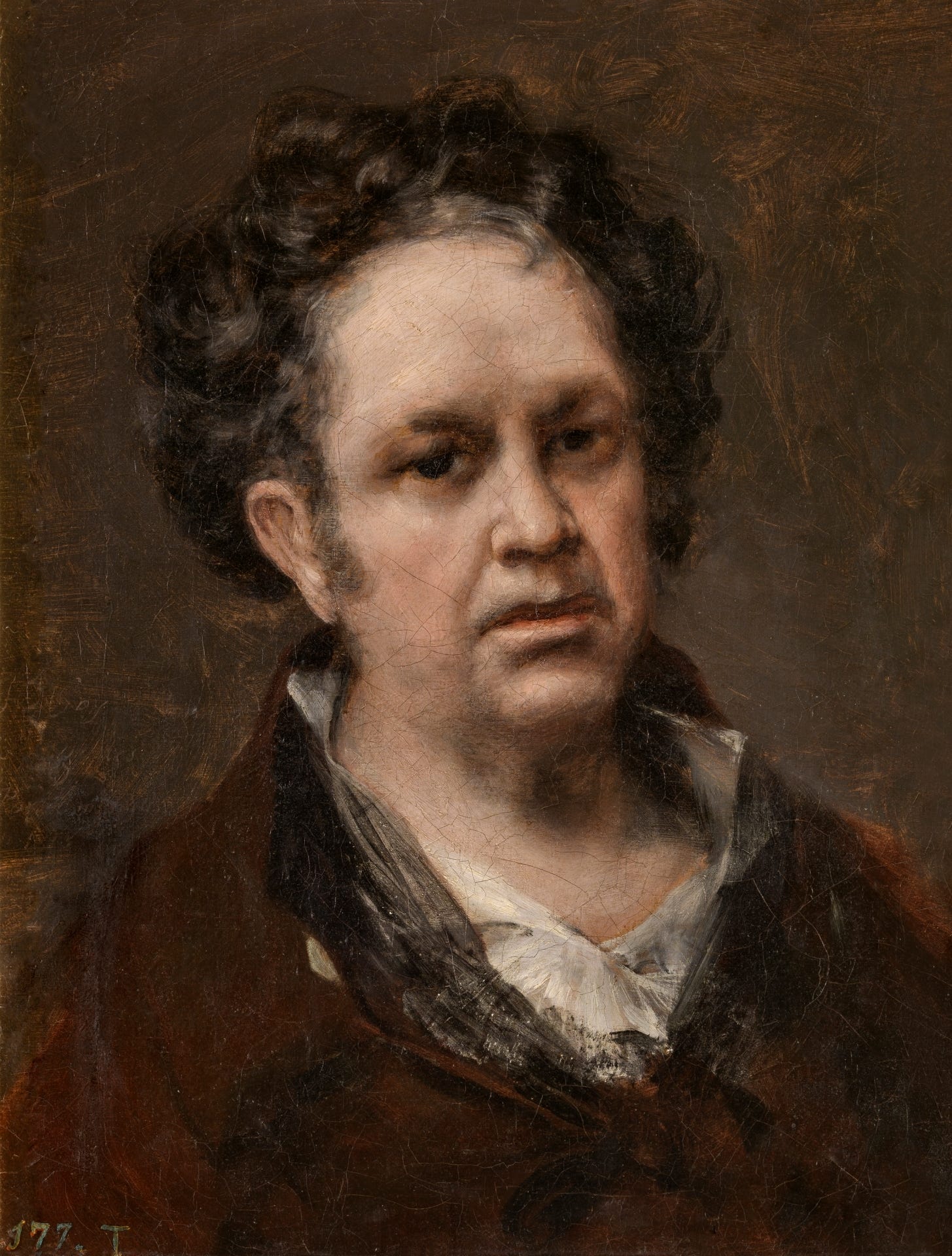
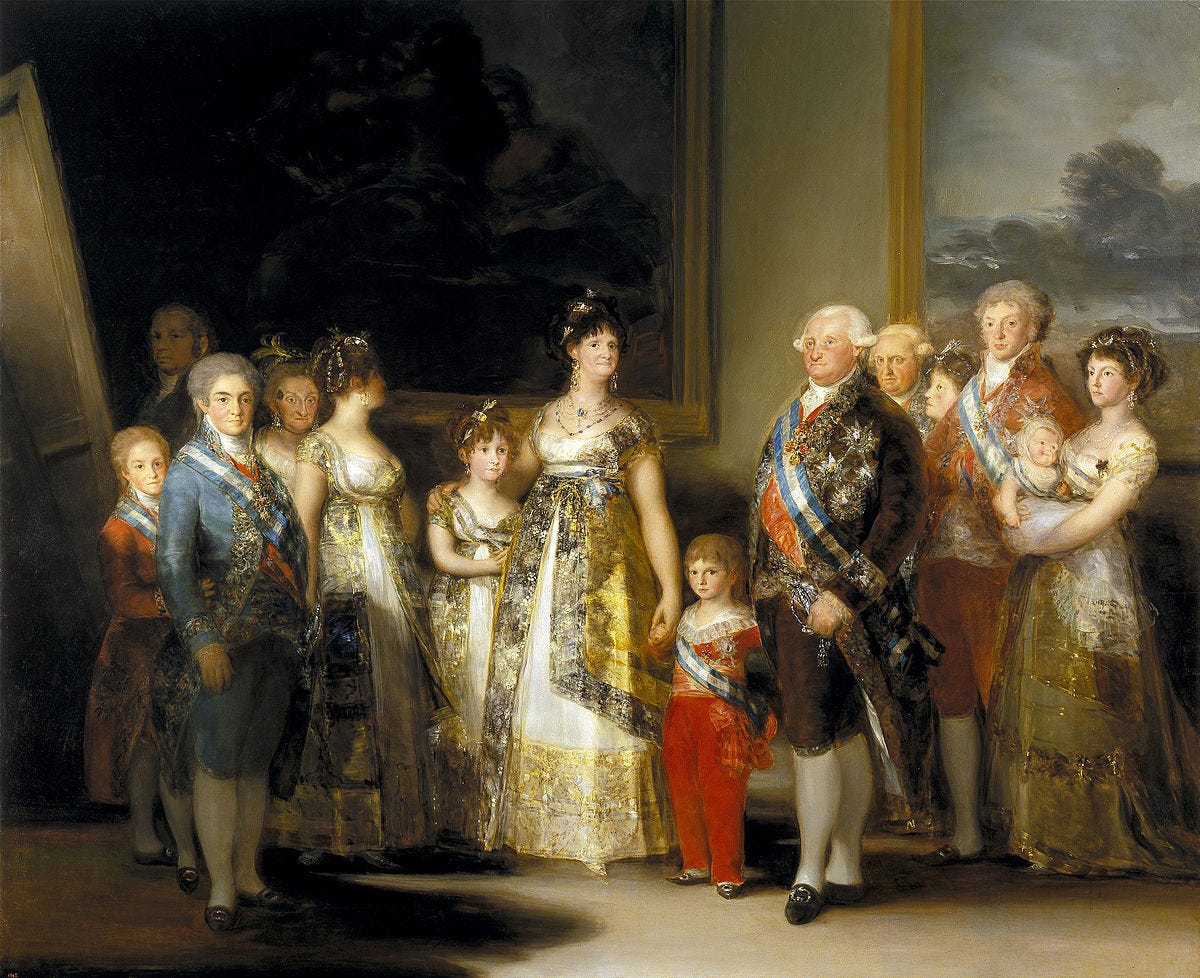
However, prior to achieving the widespread prominence for which Goya is celebrated today, during his formative years, the artist had served as a royal court painter to the Spanish crown. It was within this period that he reportedly ‘found his true vocation in secular painting’ (Hughs, 2003), with a particular work of prominence from this period, titled King Charles IV and His Family (see Figure 2). Within this example, Goya consciously depicts such regal figures with almost photographic realism, emphasising such physical flaws, and the perhaps intentionally overlooked aspects that ultimately humanise those who occupy the highest echelons of society. Unlike the grandiose, idealised royal portraits of his contemporaries, Goya’s depiction of the Spanish monarchy exposes their humanistic traits, fundamental imperfections that arguably ‘disconnect between their elevated status with their fallible nature’ (Perspective, 2023). As a consequence, this prompts further inquiry concerning Goya’s instinctual role as an observer and the greater societal responsibilities he perhaps held; creating a nuanced commentary on both the monarchy under which he operated, as well as the overarching political climate of the time.
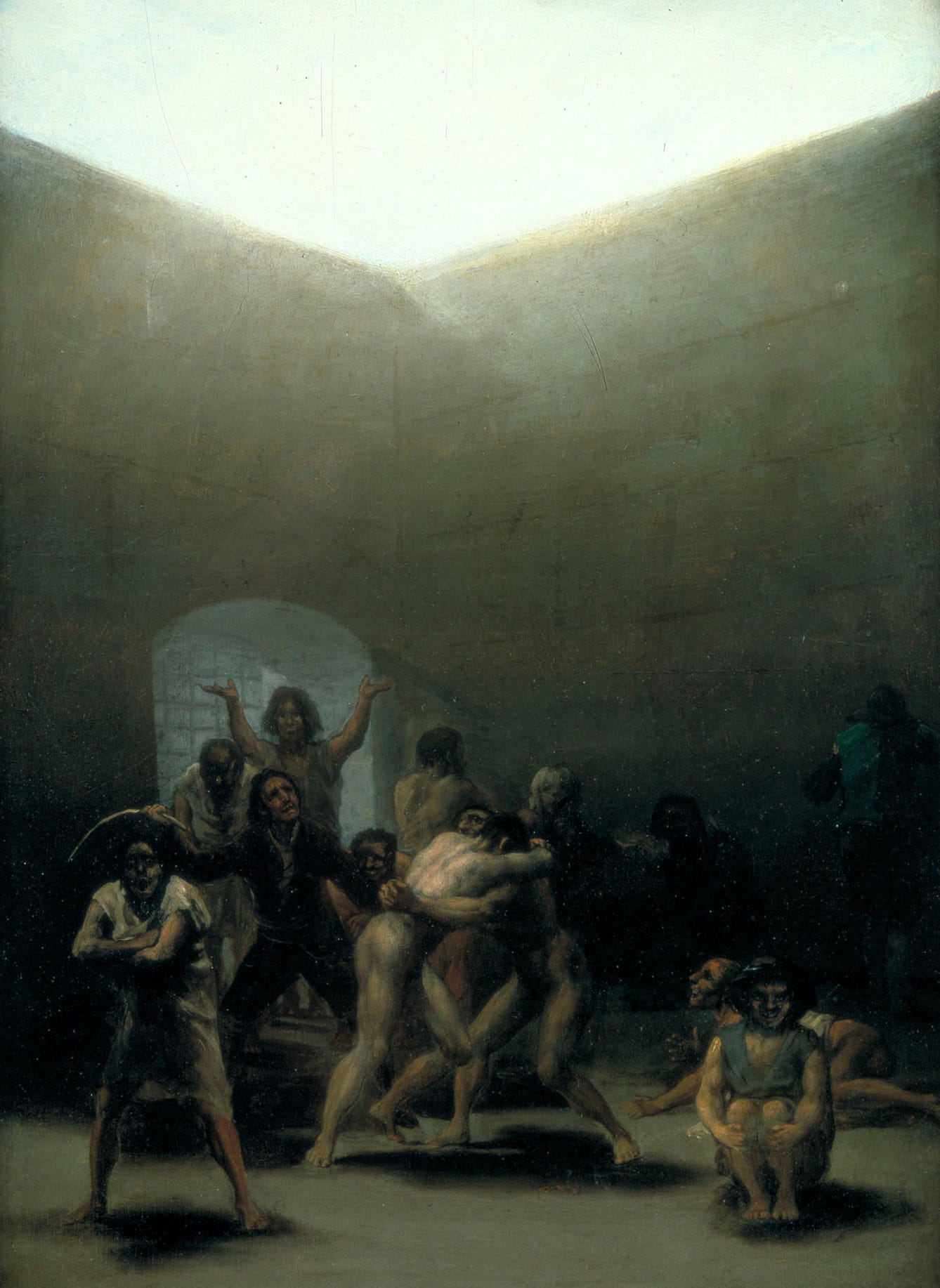
Goya’s artistic trajectory underwent a profound transformation following a pivotal personal crisis. At the age of 46, the artist had suffered a seemingly inexplicable illness (Rose, 2006), which had rendered him entirely deaf; marking a critical turning point and perhaps the stimulus for the art he produced as a result. Notably, with the onset of this sudden disability, Goya’s deafness as a result ‘led to an increasing reliance on his imagination, (Perspective, 2023). A prime artwork exemplifying this immediate transition, plainly titled Yard With Lunatics (see Figure 3) signalled Goya’s seemingly inevitable descent into madness. The scene depicted within this work, brings to personifies a scene that Goya reportedly recalled from his youth in Zaragoza. By repute, Goya has described his artwork as a ‘sombre vision of human bodies without human reason’ (Hagen et al. 2003); conveying a dismal and piteous view of humanity. Alongside this however, Goya has reportedly admitted that the works from this time were created as a reflection of his self-doubt, anxiety, and the growing fear that he was succumbing to madness, stating that his paintings served to ‘occupy my own imagination, tormented as it is by the contemplation of my sufferings’, (Danto, 2023). Whether this work was ultimately ‘medically motivated (Bahr, 2018) or by contrast an ‘outflow of a tormented great soul’ (Lubow, 2003), remains unanswered. Despite this, what remains clear is that Goya’s unique experience of deafness and personal anguish deeply shaped the emotional intensity and dark vision that defined this period of his work.
Universal Expression, a Reflection of Truth?
Goya was above all, a Romantic painter. At its very core, this artistic movement embodied the eminent progression of European idealism and virtues; all of which directly contrasted to the events which would occur in the late 17th and early 18th centuries. Within this given context, this period was categorised by two pivotal historical developments; the Enlightenment and the Spanish Inquisition. The period of Enlightenment, heralded as an era by ‘which human compassion could be realised through political action’ (Lively, 1981), promised a critical advancement of both intellectual and philosophical understanding. However, Spain remained stagnant. The unrelenting pursuit of political dominance had dramatically ‘dragged Spain back into the dark ages’ (Tomlinson, 2021); an archaic and callous regression amidst an era of such intellectual growth rising to prominence throughout the rest of Europe. As Pinker aptly suggests, ‘the ideals of the Enlightenment are products of human reason, but they always struggle with the other stands of human nature’ (2018). The entrapped, and stagnated position of Spain only exacerbated Goya’s utter despair as to what his country could have potentially surmounted to, but instead only fuelled his inherent disillusionment. He had seen so much hope, so much potential as to what Spain could have achieved, all of which Goya ultimately never experienced.
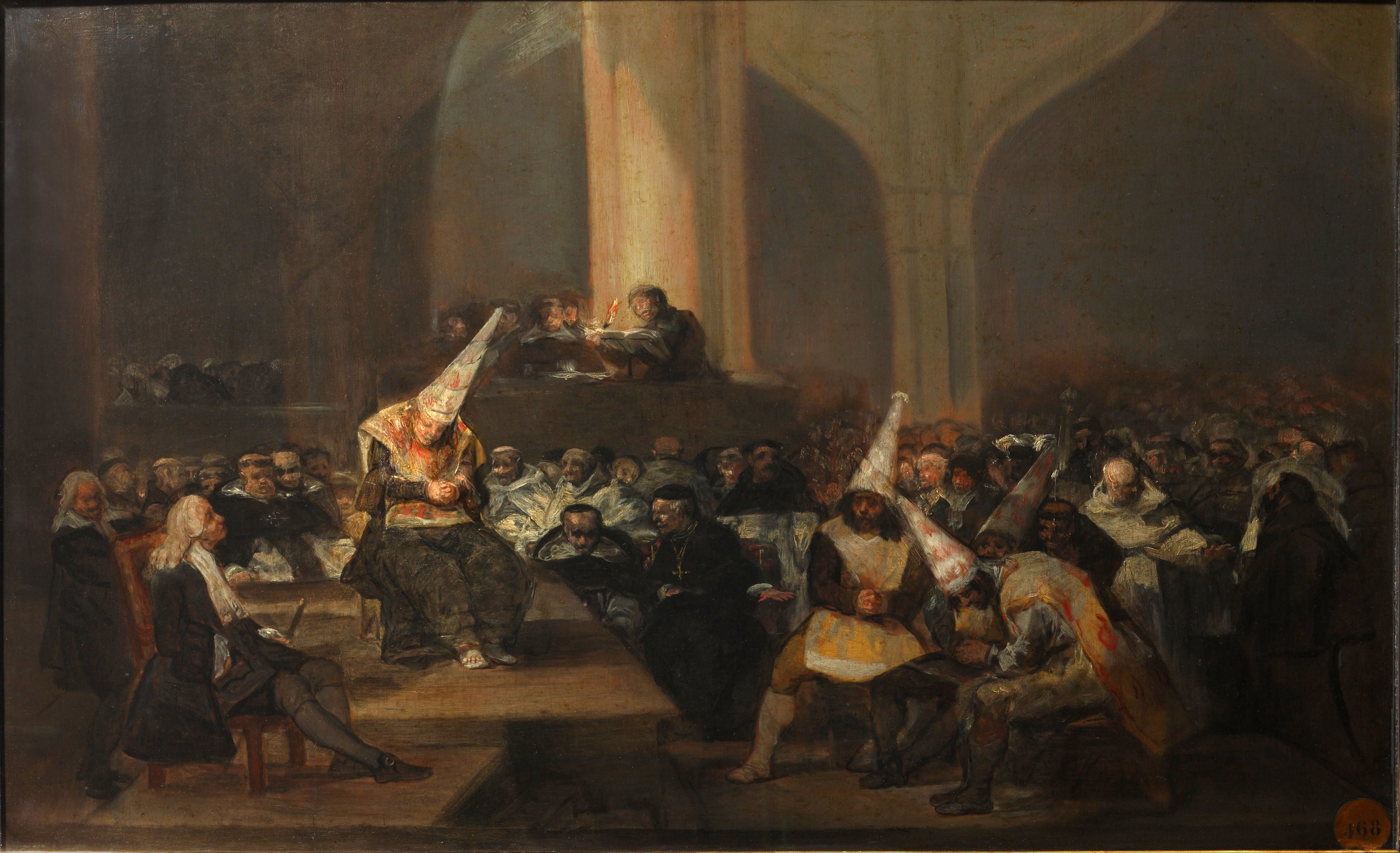
In the scene of The Inquisition Tribunal (see Figure 4) Goya depicts the shadowed interior of a church, undergoing an Autos-Da-Fé; a ritual of public penance which occurred under the fervent reign of the Catholic Church. Here, Inquisitors, known to be specialised priests, endeavoured to eradicate heresy by extracting confession, regardless of whether true or not from the accused; ‘instilling medieval fear in a modernised society’ (Tomlinson, 2021). Focused at the centre of the canvas, submissive, gaunt figures are positioned reverently with clasped hands of desperation, which further suggest ‘the disarray and fear that dominate the minds of the prisoners” (Hughs, 2003); only reinforcing the blatant, yet primitive acts of cruelty facilitated by man. Further, by the practices of the Inquisition, an official declaration from Pope Innocent III asserts that ‘anyone who attempts to construe a personal view of God which conflicts with church dogma, must be burned without pity’ (Bush, 2015). Goya’s striking yet solemn display amplifies a direct intersection between religious prevalence, and fear-mongering of the wider public; a sincere depiction of the Inquisition’s reign that not only stifled intellectual and philosophical progression, but also embedded a pervasive climate of fear and submission within Spanish society. Reiterated further by Rawlings, ’Goya thus invites the viewer to perceive the Inquisition as a barbarous, inhumane institution, emblematic of Spain’s backwardness and its failure to embrace the concepts of liberty and reason, associated with the modern age’, (2012: 15).
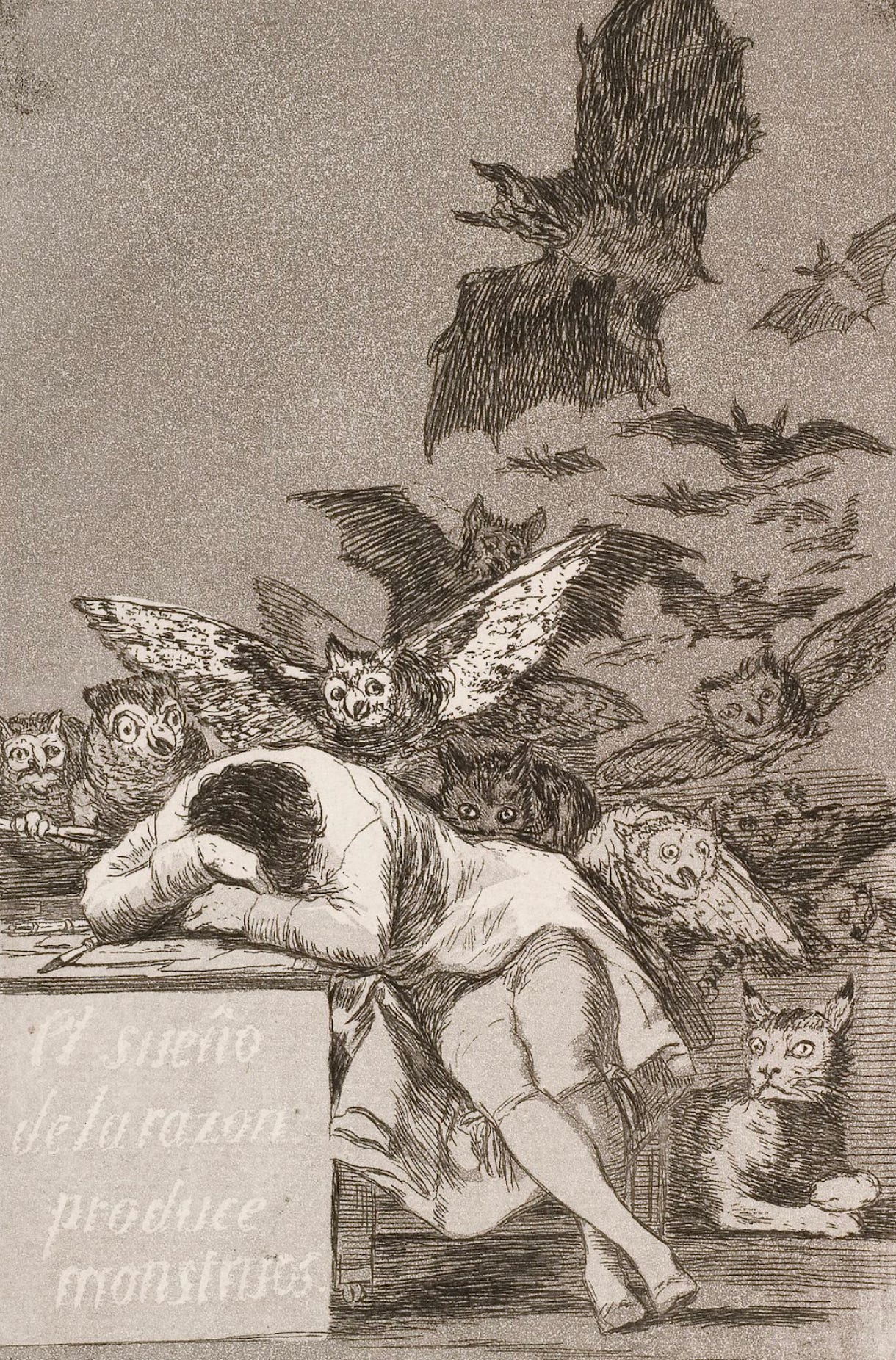
In direct relation to Goya’s profound disillusionment with Spanish society, Goya would go on to explore the images that had plagued the darkest recesses of his mind, and convey these sentiments through a series of etchings and sketches, titled Los Caprichos or Caprices, served to primarily ‘highlight the ignorance of an unenlightened society’ (Tomlinson, 2021). It became evident through his work that Goya had become increasingly critical of the Church’s systematic abuses of power and rigorous Catholic dogma; weaponising fear and superstition in order to maintain control over an ignorant, oblivious population. Goya viewed the Spanish Inquisition to be emblematic of the broader failure of Spanish society, and as a result, Goya became ‘deeply pessimistic and cynical’ (Symmons, 1998); a pertinent theme evidenced throughout his Los Caprichos. A famous etching from Goya, The Sleep of Reason Produces Monsters (see Figure 5) exemplifies the failure of the reasonable, logical mind ‘in which (Goya) took the opportunity to show the hypocrisies and follies of an unenlightened population’ (Great Art Explained, 2023) whilst simultaneously, critiquing both the vanity and ignorance of his contemporary society. Reason is dormant. The etching itself illustrates the failure of rational thought within an illogical society, where ignorance is deliberately perpetuated to maintain this dynamic of power. This piece also proposes the question: what is truly more terrifying, the truth or the human imagination?
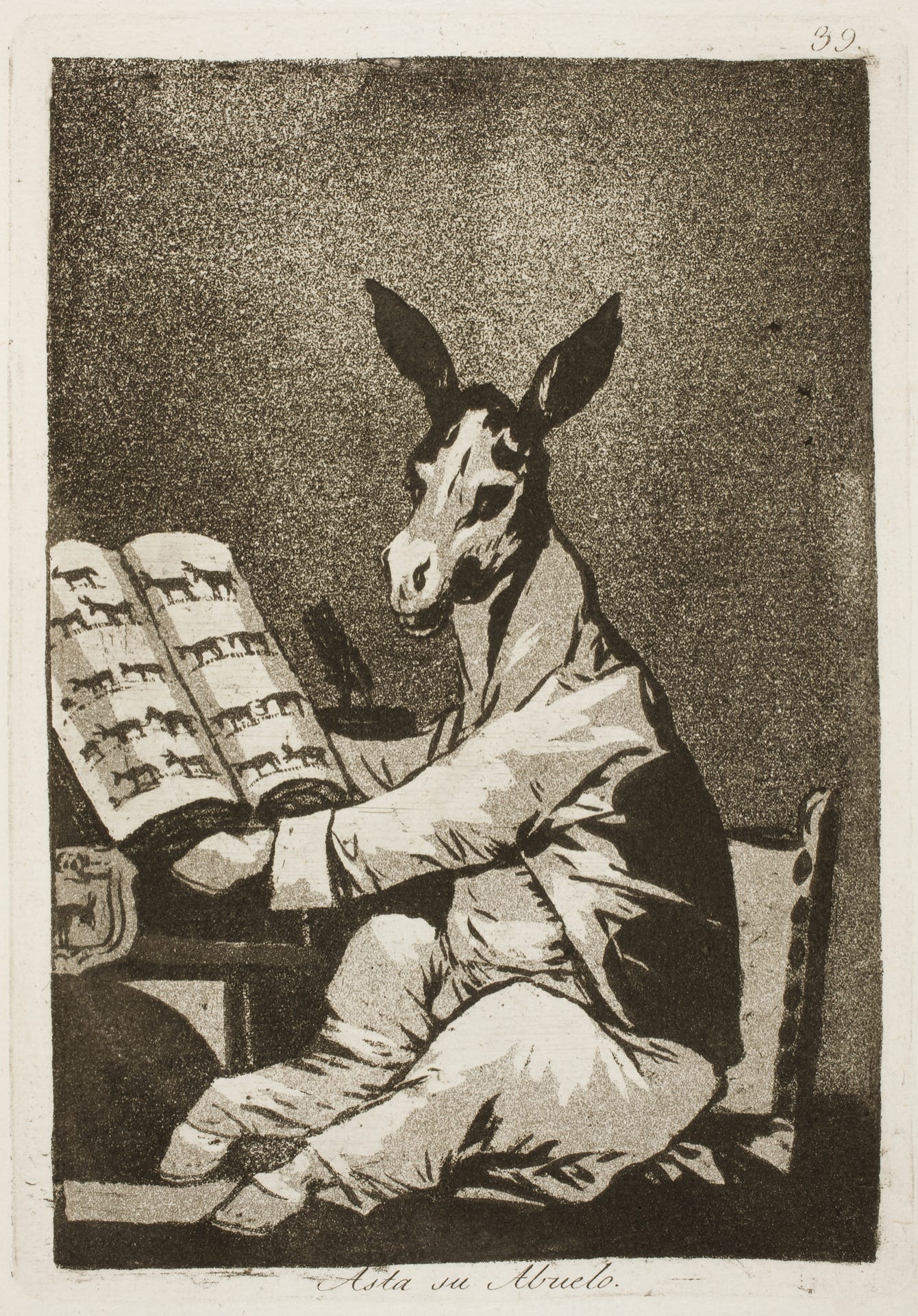
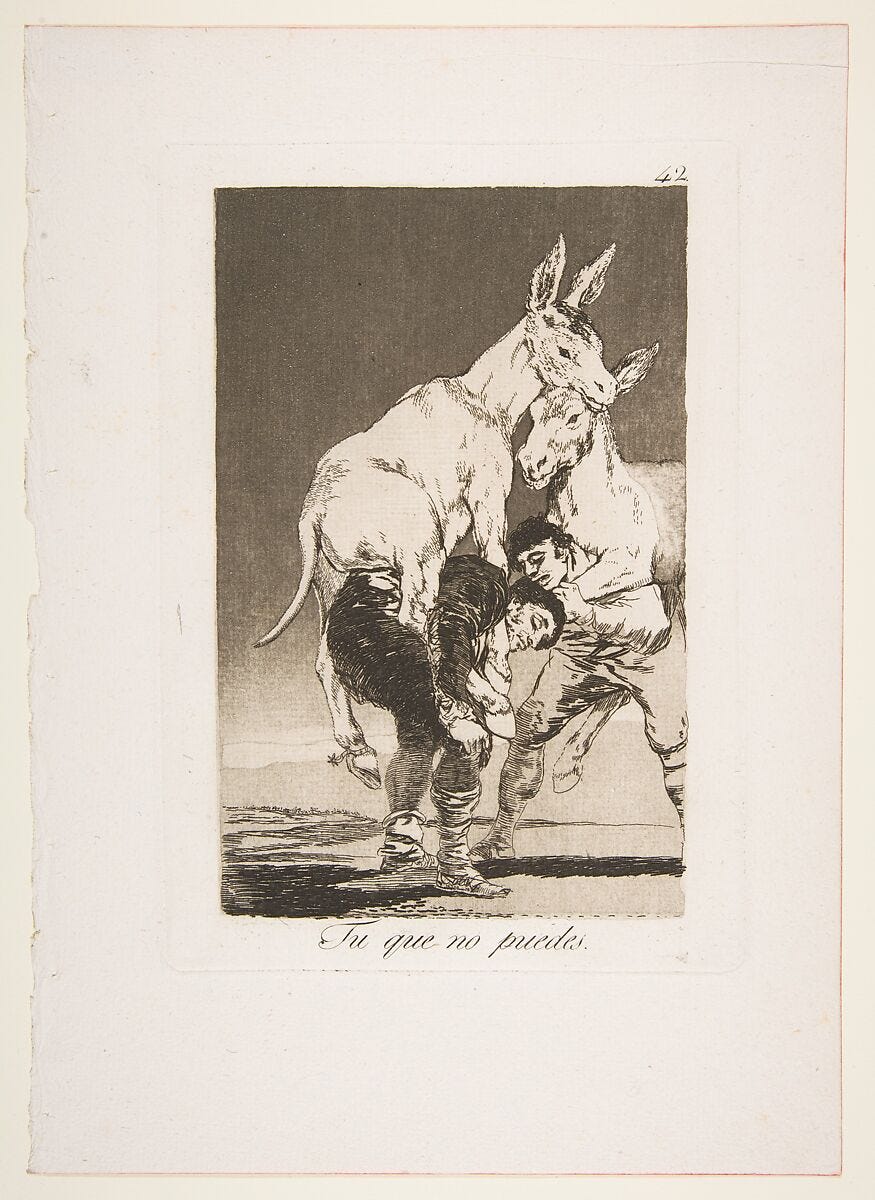
However, a pertinent motif dispersed throughout the collection is that of the donkey, an icon in which Goya is able to satirise the Spanish population, without bearing the consequences from high society, as it were. Notably, (see Figures 6 and 7) employ this imagery. Rather than vilifying the lower classes, Goya critiques the systems that perpetuate their servitude to the Catholic Church, responsible for cultivating such ignorance. Amplified further, the donkey, often associated with stubbornness or foolishness, appears adorned in human attire, mockingly educated, yet fundamentally unchanged in nature. This further implies the futility of superficial attempts at reform, when fundamental societal issues remain unaddressed. This greater symbolism underpins Goya’s disdain for a society ‘shielded from progress’ (Tomlinson, 2021), where Spanish civilians, regardless of their social status or class, fall victim to the hypocrisy and manipulation of prevailing societal structures.
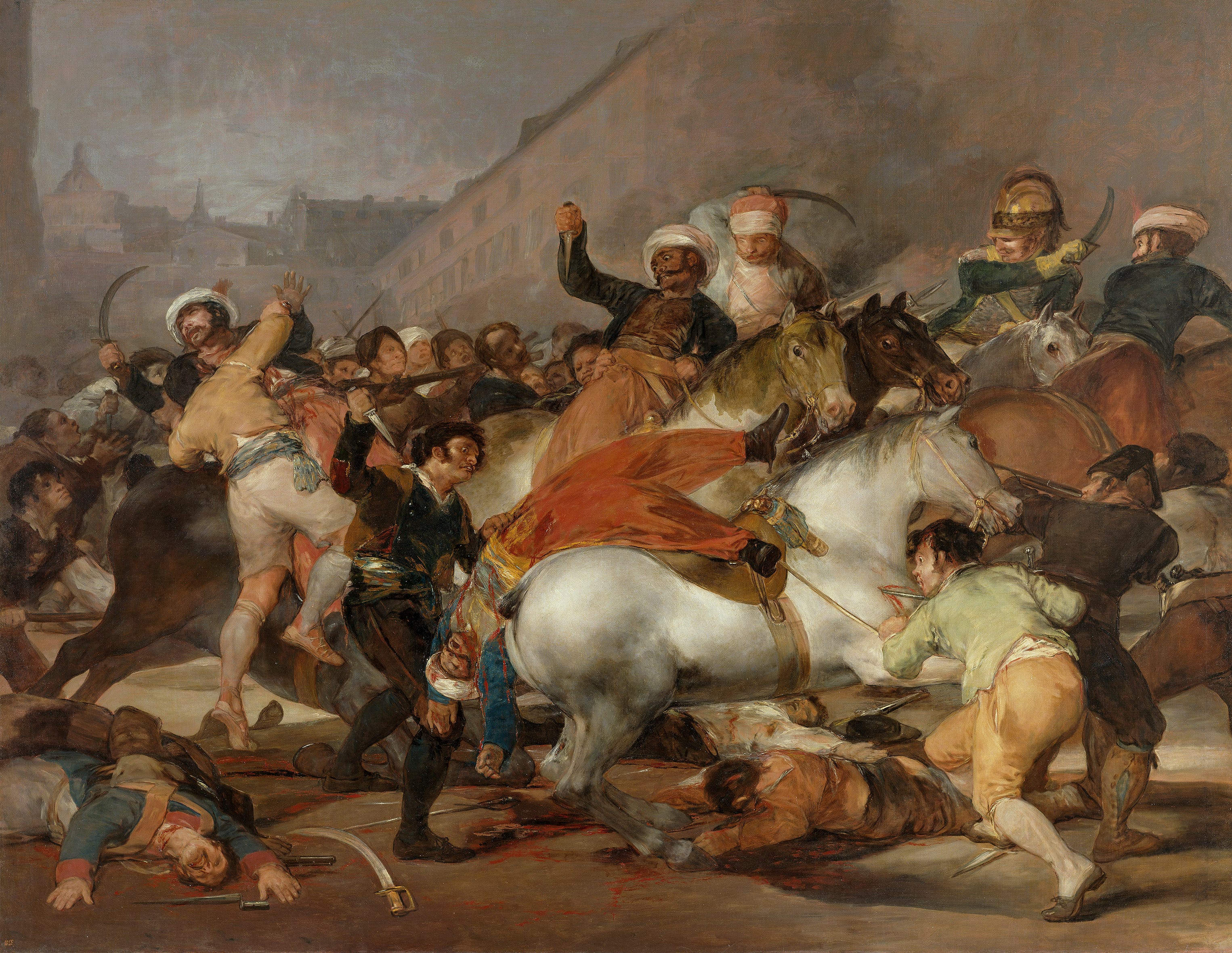
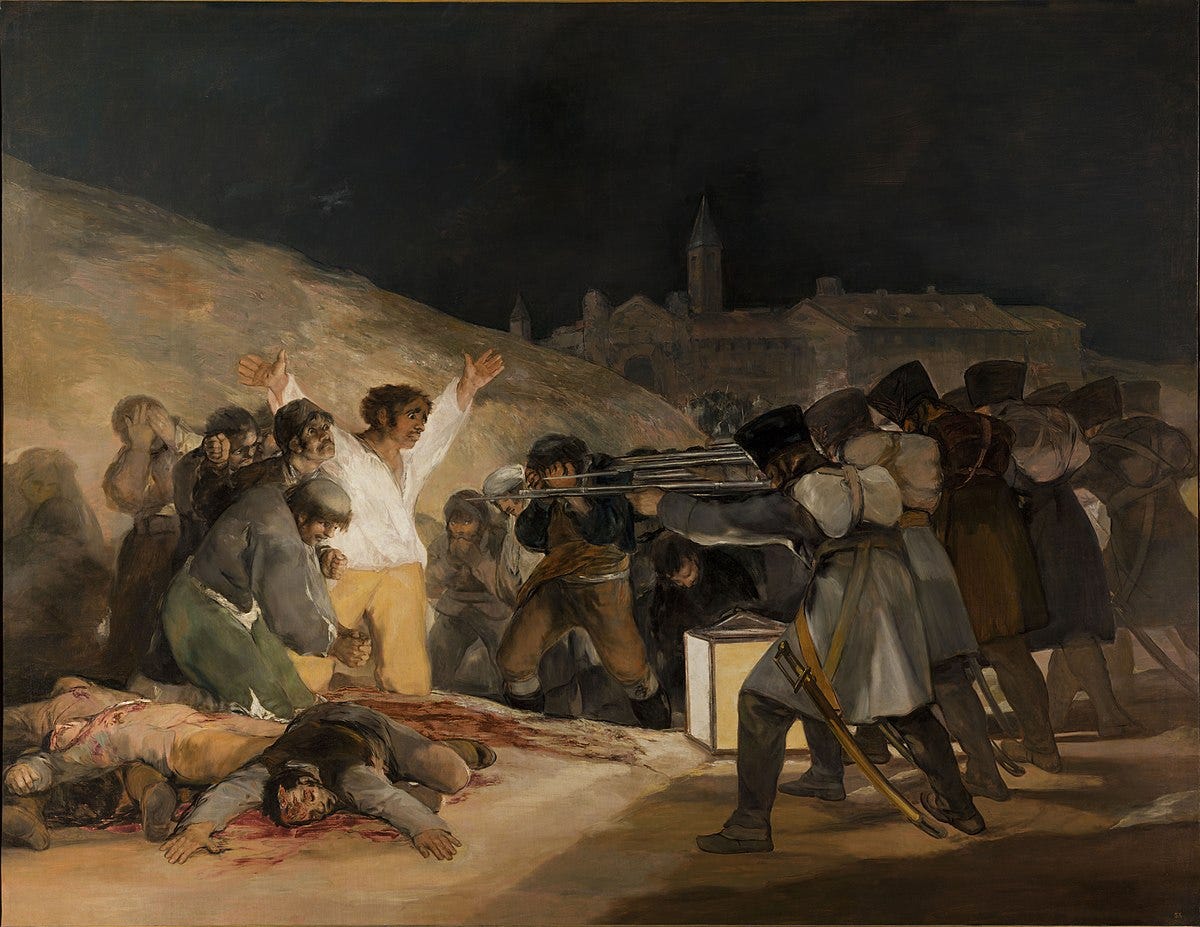
During the tumultuous period of the Peninsular War, spanning from the years 1808 to 1814, it was in this time that Goya produced two of his most significant political works, titled respectively The Second of May 1808 and The Third of May 1808 (see Figures 8 and 9), which the latter work in particular is esteemed for its ‘lauded for its […] poignant portrayal of man’s inhumanity to man’, (Zappella, 2017). The pair of artworks commemorate the events of the war, with the first example depicting ‘a band of Spanish loyalists (who) tried to regain power in Madrid’, and the following day, ‘French troops march(ing) hundreds of confirmed and suspected rebels out of the city to shoot them’ (Arn, 2019). With the Napoleonic empire reduced to ruins six years following the conflicts, Goya completed two large-scale canvases to commemorate the events of the rebellion; the second of May uprising, and the harrowing executions the subsequent day. This poses the question, why is it necessary to document such atrocities? Focused heavily in the second example, as opposed to capturing triumphant, and glorified victories of war, Goya accurately portrays a raw, unfiltered reality of human destruction. A central figure with his hands raised in desperation, provoking a wider sentiment of innocence, contrasted with the absolute absurdity and atrocities of warfare enforced onto civilian populations. The mechanical uniformity of the oppressors to the right remain anonymous; stifling traditional depictions of military valour, reducing man to mere tools of destruction. As Clark indicates, Goya’s Third of May ‘is the first great picture which can be called revolutionary in every sense of the word—in style, in subject, and in intention’ (1960, 130). Goya does not intend to blemish or even distort the actuality of events that occurred, but to instead allow onlookers to directly confront the darker, and more cynical aspects of human nature that are often omitted entirely.
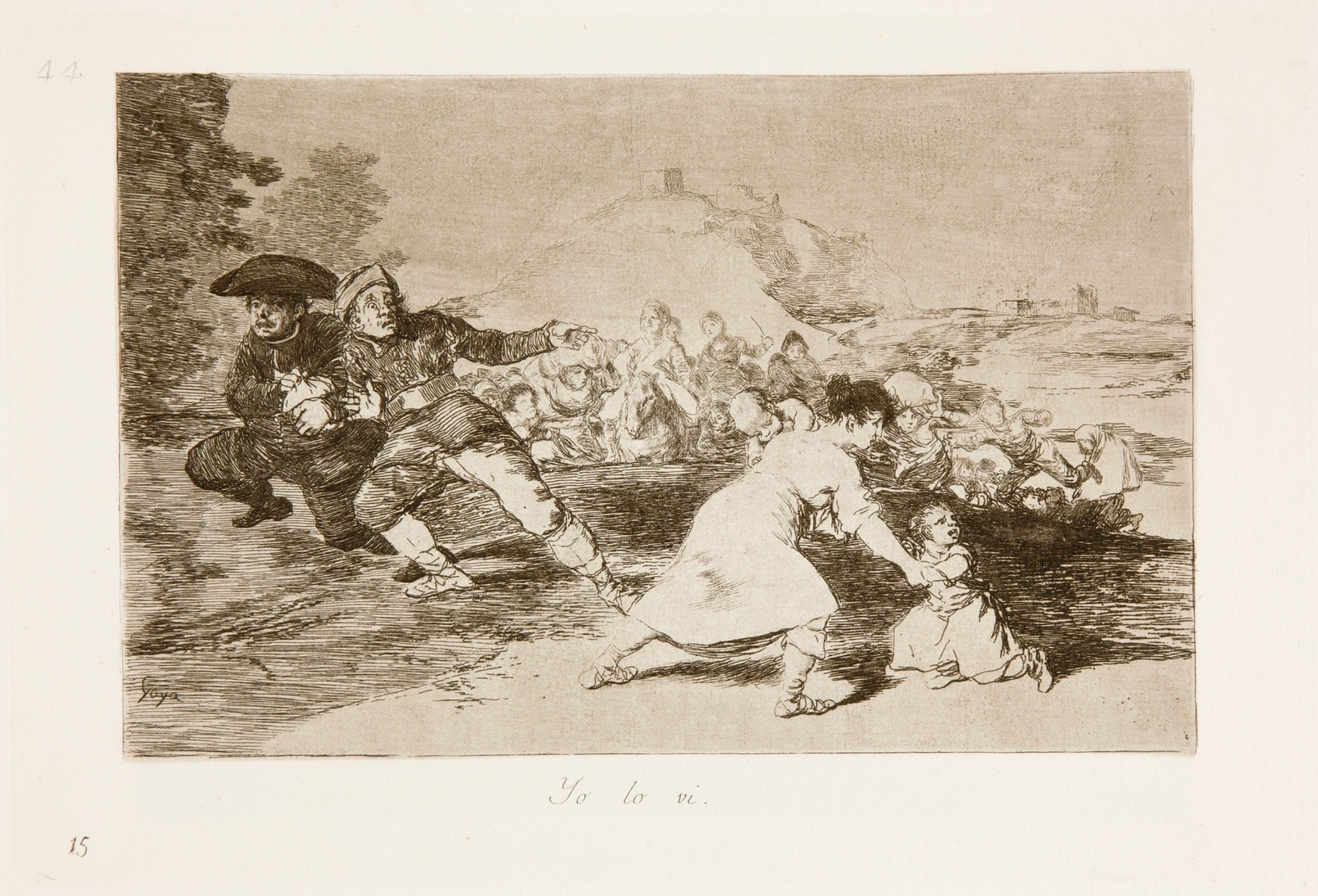
Following the events of the war in Spain, Goya began his penultimate series of approximately 85 etchings spanning from the years of 1810 to 1820, formally titled The Disaster of War; a title offered by the Academy of San Fernando who published the set 35 years after Goya’s death. Goya ‘was not artistically tied nor constrained to a particular style, theme or approach’ (Burns-Dans, 2018) and demonstrates his utter loss of agency, and the futility of conflict through his etched works. This series ‘stand almost […] as a record or pitiless inhumanity and more, the purposelessness of war […] sink(ing) into a morass of murder’ (Williams, 1976). A particular example, solemnly titled I saw it (see Figure 10) depicts a chaotic and fragmented scene of civilians caught in the devastating crossfire of conflict. The foreground scene is greatly distanced from the background or war, creating a direct focus on the civilian figures; a vivid image that bluntly captures the unrelenting nature of human suffering that invites humanity to reckon with its cynical behaviours. Such macabre themes are demonstrated throughout the entirety of the collection, but especially poignant scenes of famine, rape, and executions are all prevalent themes that Goya intended to communicate in this fashion. It is important to note that this wider collection is not necessarily deemed as propaganda as such, but more so reportage of what Goya bore witness to; again offered by Williams, ‘a dialect of reason and unreason’ (1976, 173). Goya’s haunting ability to distil the sheer absurdity, and insanity of human cruelty along with the devastating consequences and folly of warfare, allow these works not only to be interpreted as distant historical records but as timeless, moral indictments of violence that continue to resonate to present day.
The Darker Aspects of The Human Psyche
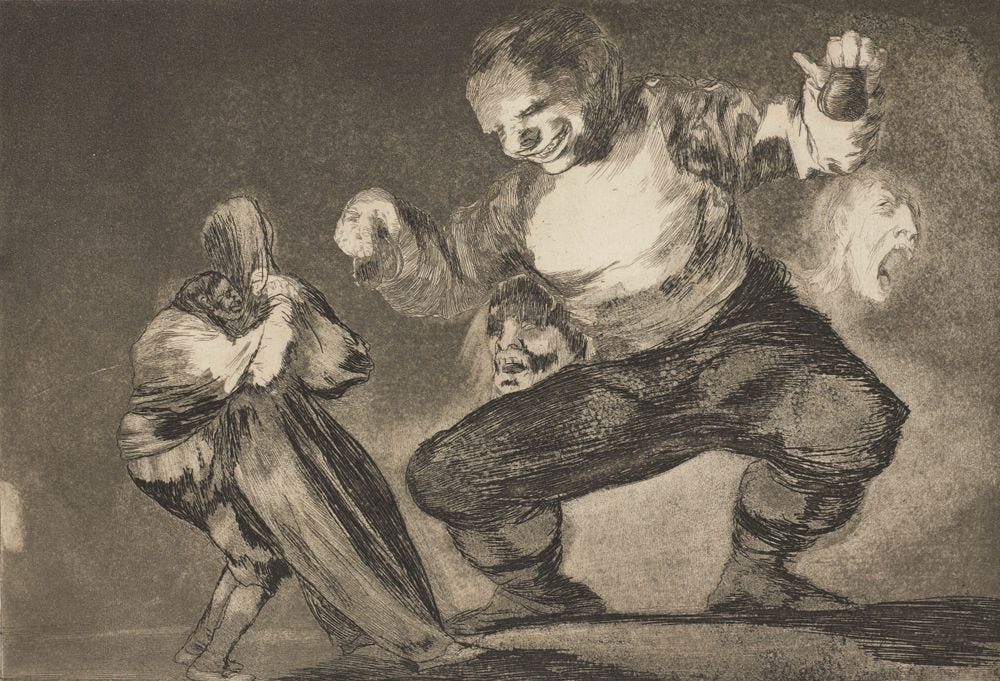
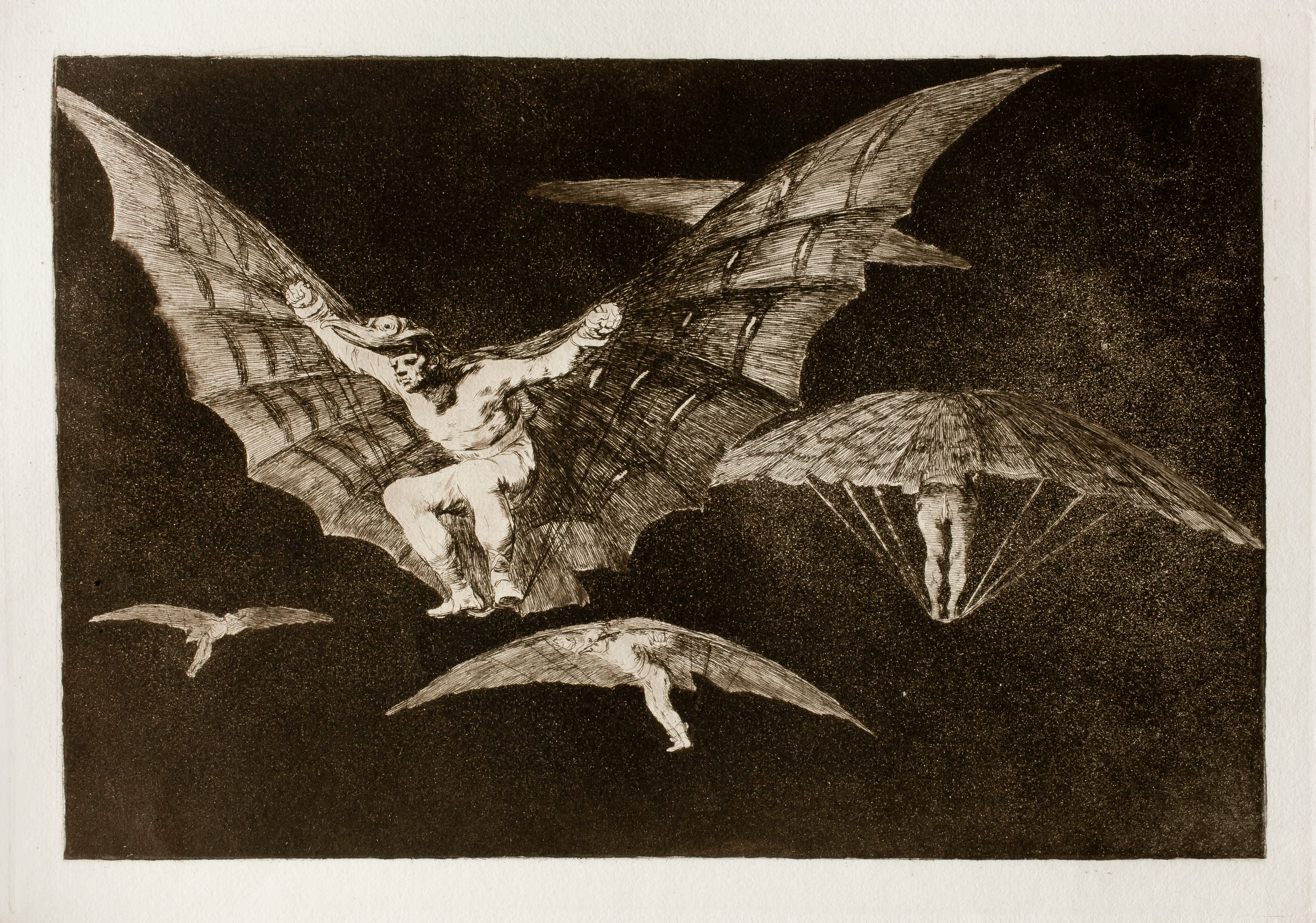
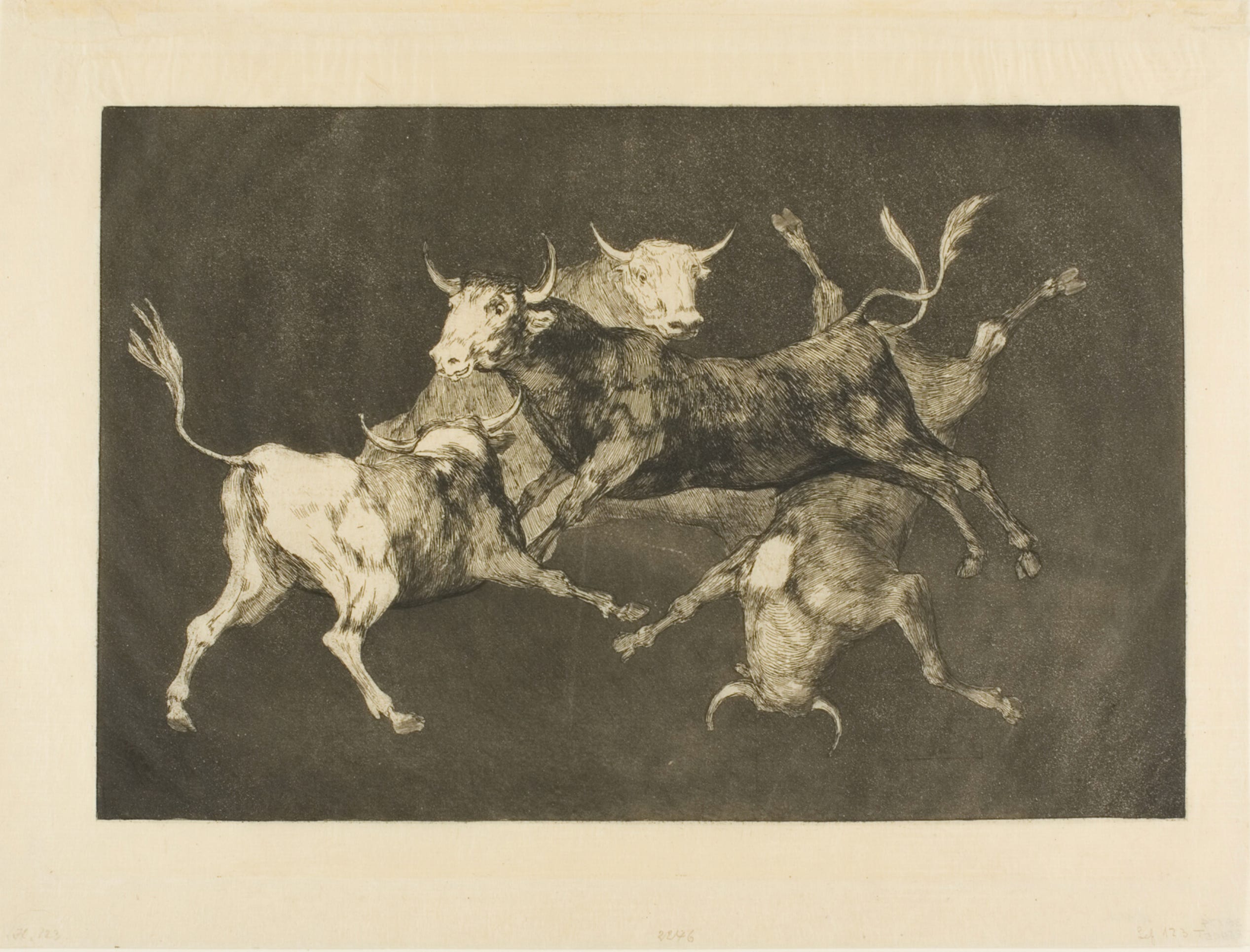
In his later life, several years after Goya’s responses to the Peninsular War, the artist focused his attention on assembling his final etchings; when Goya embarked on potentially his ‘most mysteriously personal sequence of etchings […] which have eluded many attempts to explain them’, (Symmons, 1998) This concluding series of prints titled Los Disparates or simply Folly; all explore alternate examples of ‘folly’ so to speak. In light of this, Goya’s arguably more cryptic works were produced during his farmhouse residence, aptly nicknamed ‘la Quinta del Sordo’, otherwise the ‘Deaf man’s House’, where he had spent his remaining years in Spain. Reportedly, the artist had left these works incomplete, allowing them to ‘absorb his energies’ as an external output to his comparatively more traditional paintings (Symmons, 1998). Further, a question posited by Hughs, ‘were they to have been a public statement of irrationality and mystery?’ (2003, 366), remarks the possibility that these examples were supposed to be viewed by the wider public, perhaps a publicised sentiment of disillusionment? Notable examples include Plate 4, Simpleton’s folly and Plate 13, A way of flying, (see Figures 11 and 12) which encompass more central themes of man’s capacity for irrational and impetuous behaviours, or, even ‘objective forms taken by (his) own repressed emotions’ (Alford, 1960). Alongside these pieces, Goya initiated a separate series titled La Tauromaquia or Bullfighting in 1815. A comparatively minor series, celebrated the art of bullfighting, as an authentic, commemorative reflection of the richness of Spanish society, or at least what Goya had hoped his society to aspire to. Such examples include the plate, Lluvia de Toros, Rain of Bulls (see Figure 13) which is emblematic of Goya’s fascination with bullfighting, of which the subject matter is suspended within a considerably darker background; creating dissonance. The generalised shift towards darker, more ambiguous expressions in Los Disparates underscores Goya’s increasing preoccupation with the complexities of human folly, as his exploration of irrationality, violence, and repressed emotions challenges the viewer to confront uncomfortable truths about both society and the self.
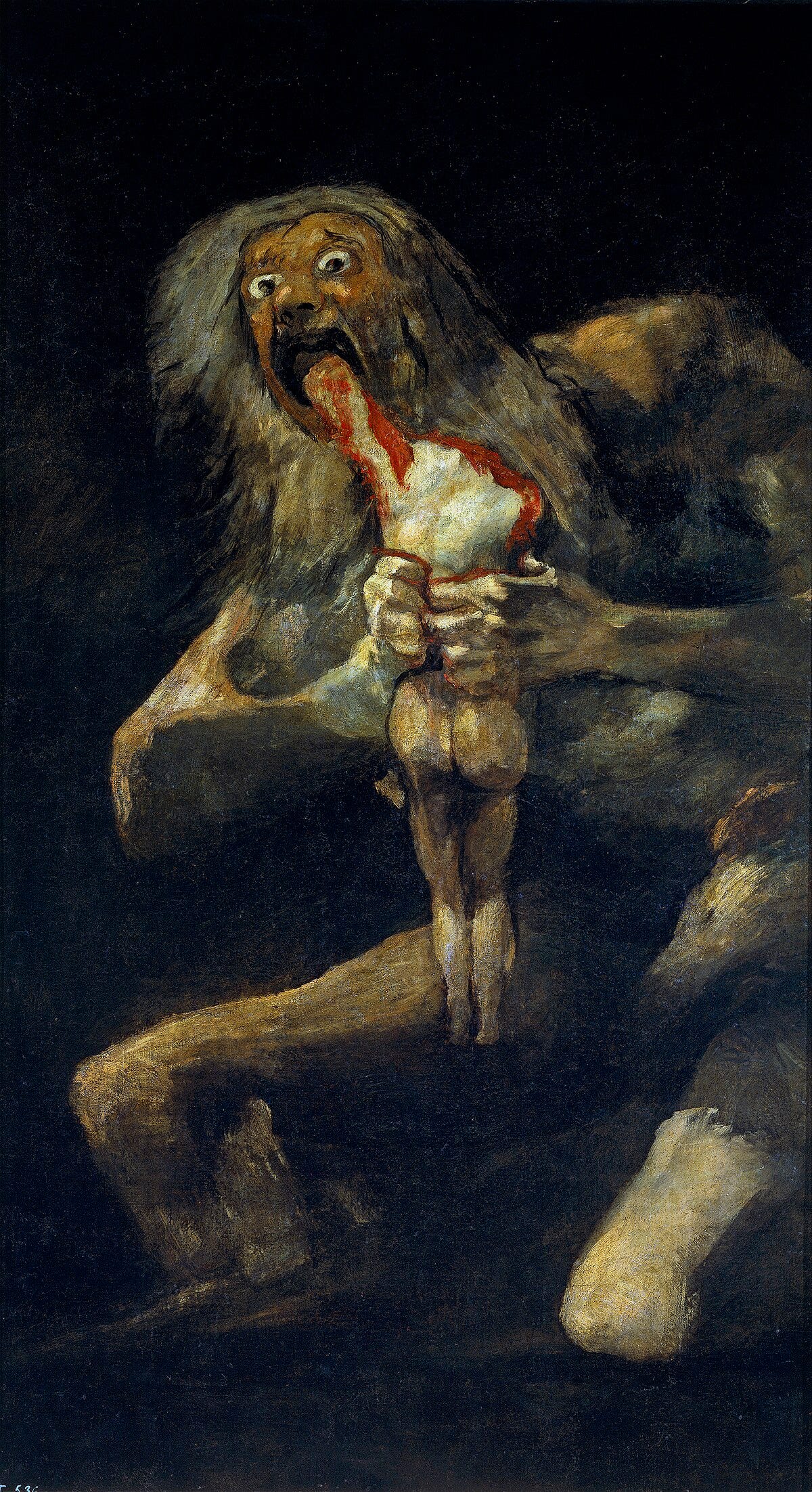
Goya’s aforementioned spiral into madness can be truly epitomised if not through his Los Disparates but shockingly, even the magnitude of his frightening imagery that manifests completely in the final years of Goya’s lifetime. Unofficially titled The Black Paintings or commonly recognised as Las Pinturas Negras is a series of fourteen fresco-like murals that Goya painted directly onto the walls of his farmhouse; unnamed, undated as he ’retreated to the life of a recluse’ (The Artist Editorial, 2023). These lone artworks were presumably created sometime between 1821 and 1823; visuals of which his ‘bleak visions’ (Phelan, 2019) offer a considerably more visceral, almost strenuous quality; exorcising his true ‘desire to plumb the depths of his own psychology in order to comprehend—and represent—the world around him’ (Gies, 1995). A renowned example, of which Goya’s name is often omitted of, Saturn Devouring His Son (see Figure 14), an example of which many neglect to consider why it was that Goya created such compelling visuals in the first place. Above all, Goya did not intend for these artworks to be seen public; especially during ‘a period where mental illness was so neglected and demonised’ (Blind Dweller, 2021), but, despite his intentions, his Black Paintings hold considerable insight into the minutiae of his incredibly complex, yet unfortunate life. An example of particular note, a title merely offered by painter Antonio Brugada, Witches’ Sabbath, or The Great He-Goat (see Figure 15). It should be noted that the original work was of considerable scale before its restorative measures, and serves as a ‘poignant’ example of the remaining works that required additional alterations. As described by Glendinning, ‘by doing this, Martinez Cubells (restorer) concentrates the whole picture around the coven itself and simplifies the composition’ (1975: 473). Due to these amendments, this begs the question if these artworks even reflected what Goya had truly intended to paint in the first place.

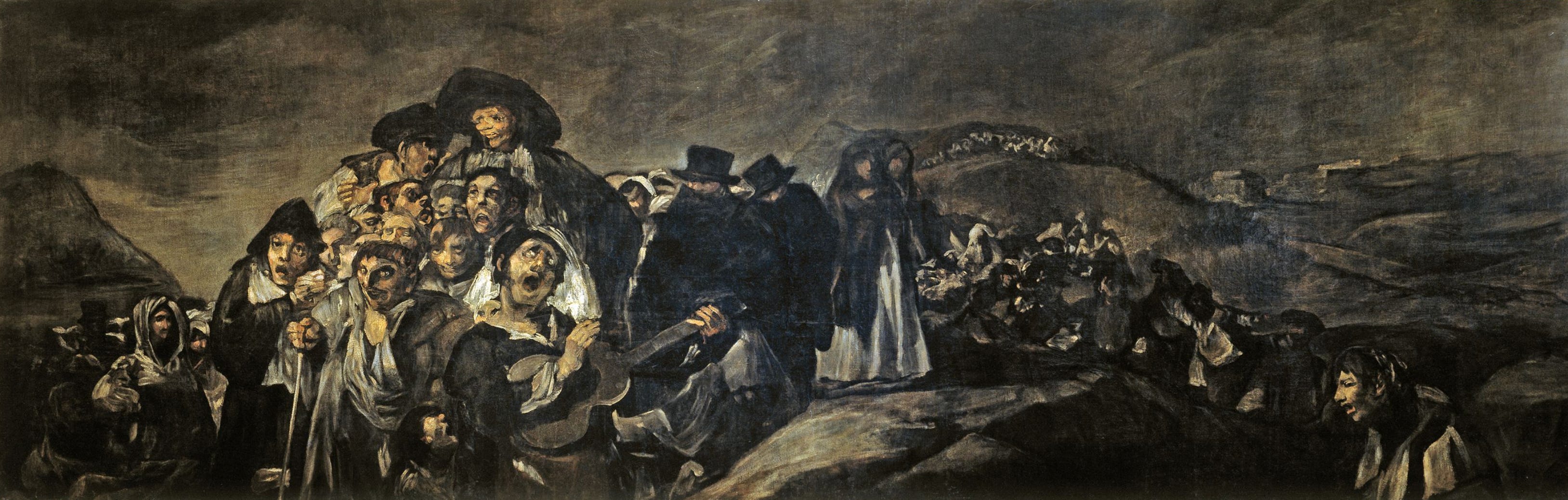
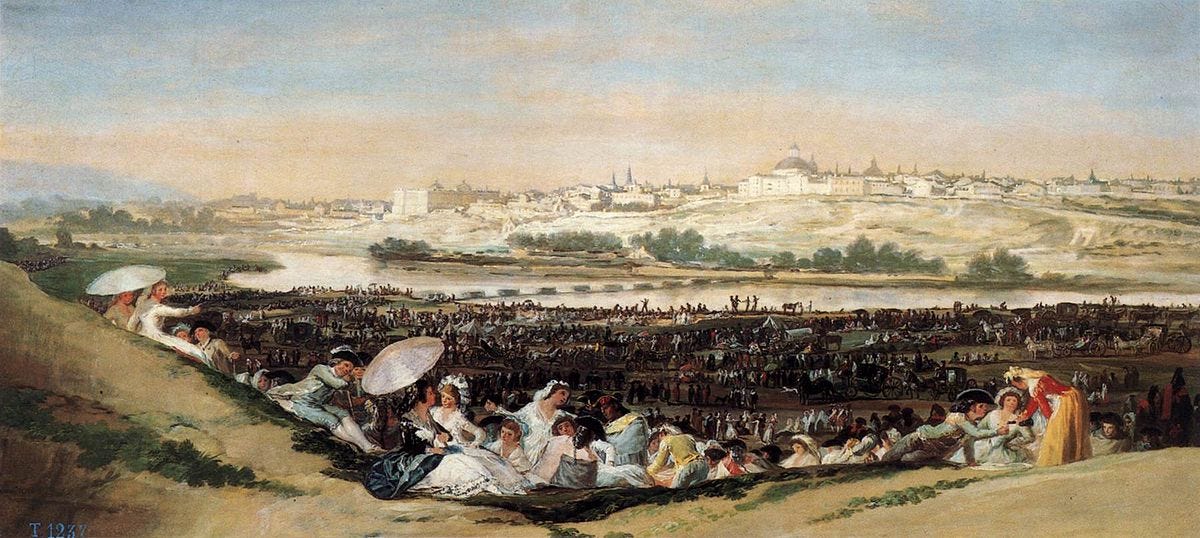
In this regard, the iconography of the goat within this greater context, offers a more comprehensive depiction of the devil as a tangible form, assuming the mortal form of a goat with a ceremonial black robe. The extended horizontal format by nature enhances the intimidating visuals presented, with an all-encompassing aspect that almost suffocates the viewer; suggesting that ‘evil is not necessarily depicted, but implied’ (Tomlinson, 2021). Similar motifs are apparent within a piece colloquially titled A Pilgrimage to San Isidro (see Figure 16), where the elongated format provides a panoramic landscape within both scenes, whilst mirroring such repleted imagery found within the similar format of its counterpart. Strikingly, this latter painting is countered with a significantly lighter sister painting titled The Meadow of San Isidro (see Figure 17), highly reminiscent of Goya’s distant portraiture of past eras. This collection of works perhaps epitomises Goya’s ultimate evolution, or even regression, that is evidenced through Goya’s vibrant optimism of what Spanish society could aspire to, to a cynical and profoundly introspective reflection of humanity’s darker realities. As aptly stated, ‘Goya still speaks with urgency, even 175 years after his death’ (Davis, 2004), a truth which is owed to the genius of Francisco Goya, communicating human nature in its most primal form; the collective experience that is inherent in humankind.
The Triumph of Nothing
Goya’s artistic legacy was not only perpetuated through his contributions to historical and political art but also influenced the likes of Pablo Picasso; an artist of immense skill and talent, over a century after his death. Picasso is often referred to as the “magpie” of the art world, due to his encyclopaedic knowledge of art history, and remarkable ability to absorb, reinterpret, and engage with the work of his artistic predecessors (Great Art Explained, 2020). Picasso’s intellectual agility allowed his work to become more expansive; drawing influence from various sources, creating a unique visual language that redefined 20th-century art. Among his inspirations, Francisco Goya stood out as a pivotal figure, with both creators possessing ‘many striking traits in common, both in life and art’ (Meyers, 2022), and in tandem with one another, have ‘defined Spanish-made art for nearly two hundred years side by side’ (Rich, 2018).
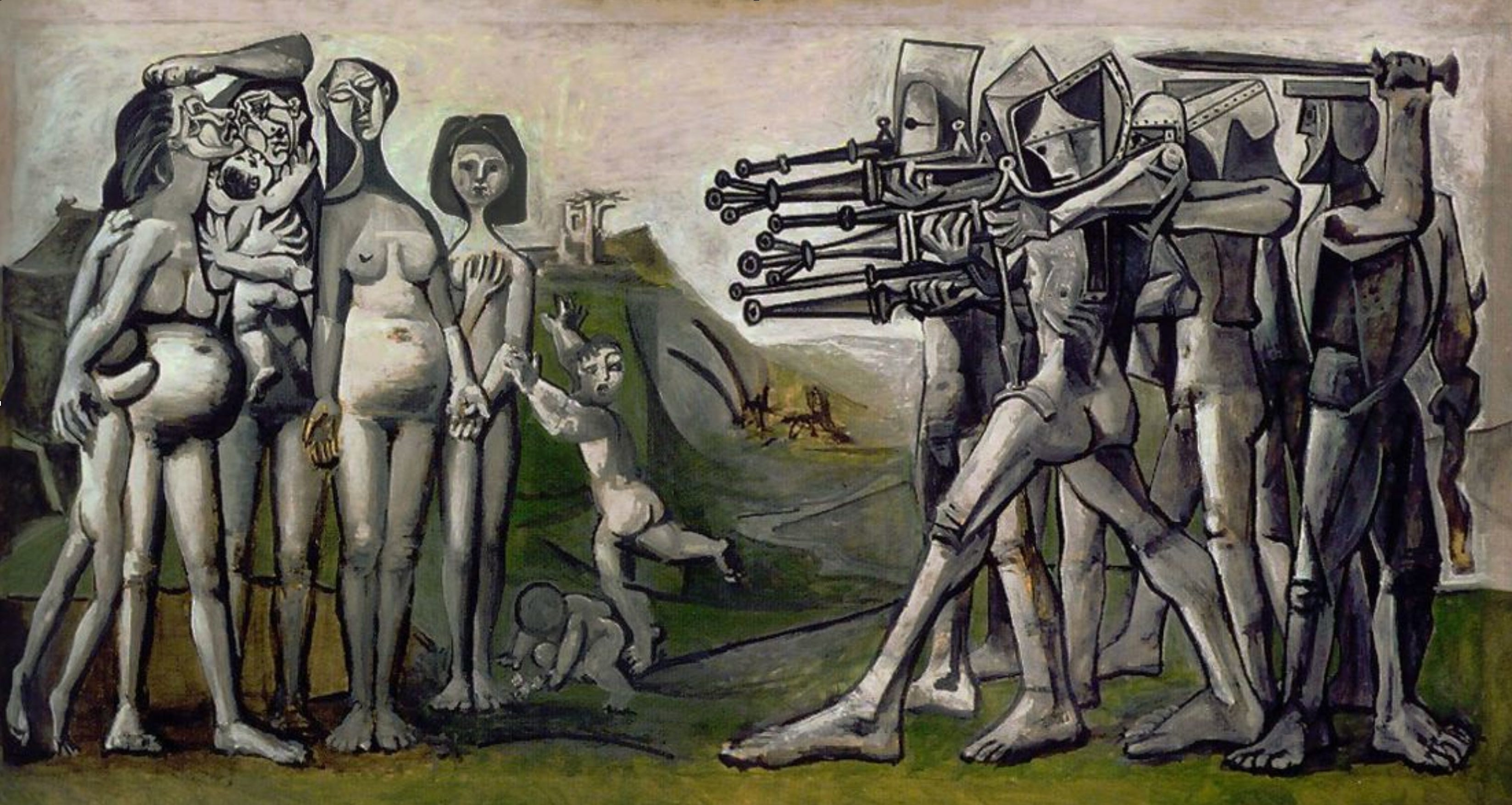
Goya, as a precursor to the modernist critique, resonated profoundly with Picasso, especially in works that documented the sufferings of man. This would consequently prompt Picasso’s own investigation of humanity’s ceaseless cruelty, a central theme throughout his later works. This influence is particularly evident in Picasso’s Massacre in Korea (see Figure 18), which notably stands as the only depiction of the Korean War to reach an international audience. The artwork strikingly draws upon Goya’s Third of May 1808, with both compositions divided vertically, with the innocent focused to the left and the perpetrators to the right. Is this emblematic of something greater? Here, Picasso has ‘transformed […] soldiers from men into machines’ (Sax, 2020) underpinning such monstrous tendencies that are seemingly inevitable in man’s behaviour. Picasso’s rendition offers an earnest reminder of the repetitive nature of human history, whilst critiquing the cyclical nature of violence and destruction which is only perpetuated by mankind. Does humanity possess an innate tendency towards such behaviour?
Picasso’s famed Guernica (see Figure 19) was created in 1937, commemorating the series of aerial bombardments, and obliteration, of the Basque village of the same name during the Spanish Civil War, on April 26, 1937, described as ‘a new catalogue of atrocities’, (Fleming and Honour, 1984). The attack itself was orchestrated by German and Italian forces under the command of Francisco Franco, Spain’s military general. The bombing was purely for show, scheduled to maximise civilian casualties; ‘a macabre rehearsal for the Blitzkrieg tactics of World War II’, (Great Art Explained, 2020). The decimation of the small town was far from a strategic military operation, but rather a calculated act of psychological warfare; designed to instil fear amongst those who opposed Franco’s fascist regime. Picasso was famously apolitical; a ‘political sleeper’ (Danchev, 2010), but at this time he had urgently remarked his ‘abhorrence of the military caste which (had) sunk Spain into an ocean of pain and death’ (Robinson, 2015).
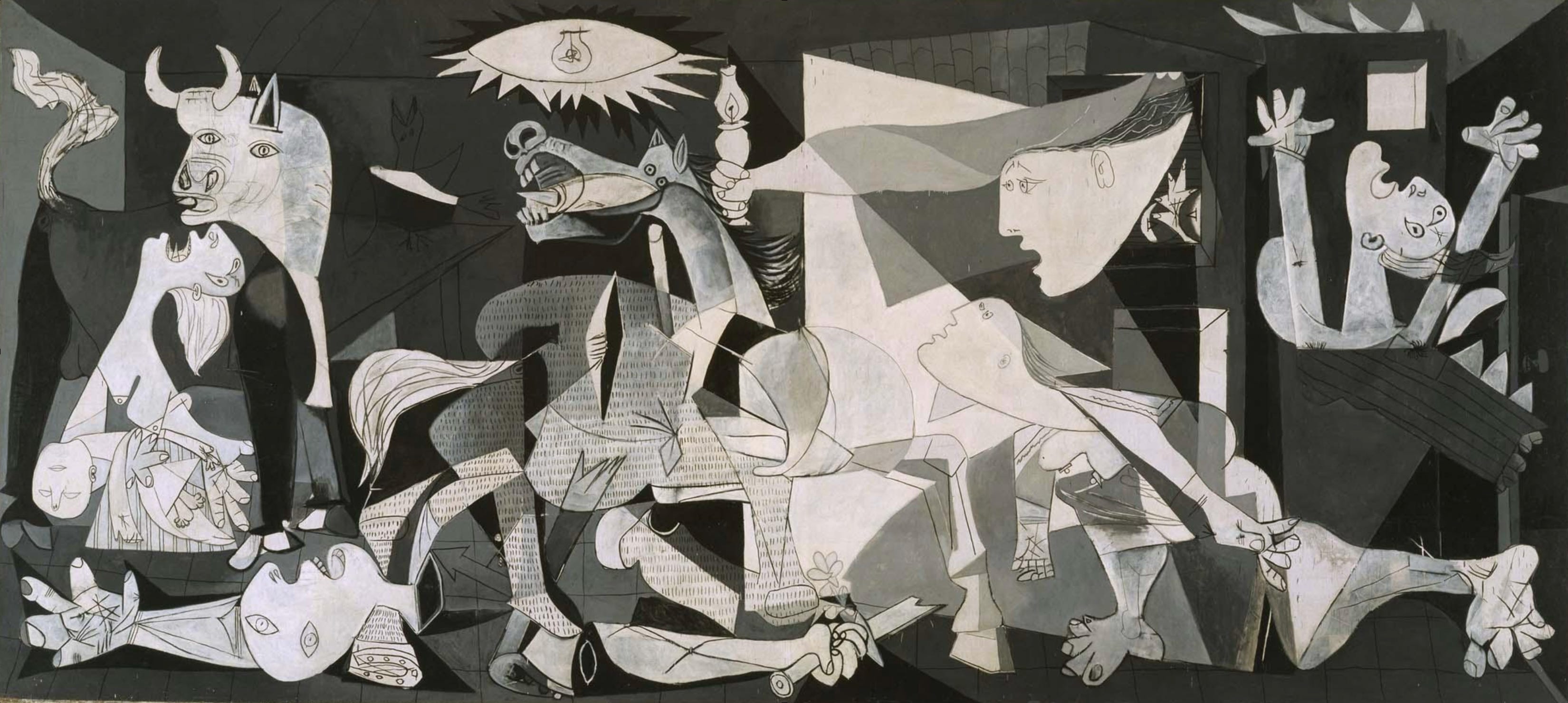
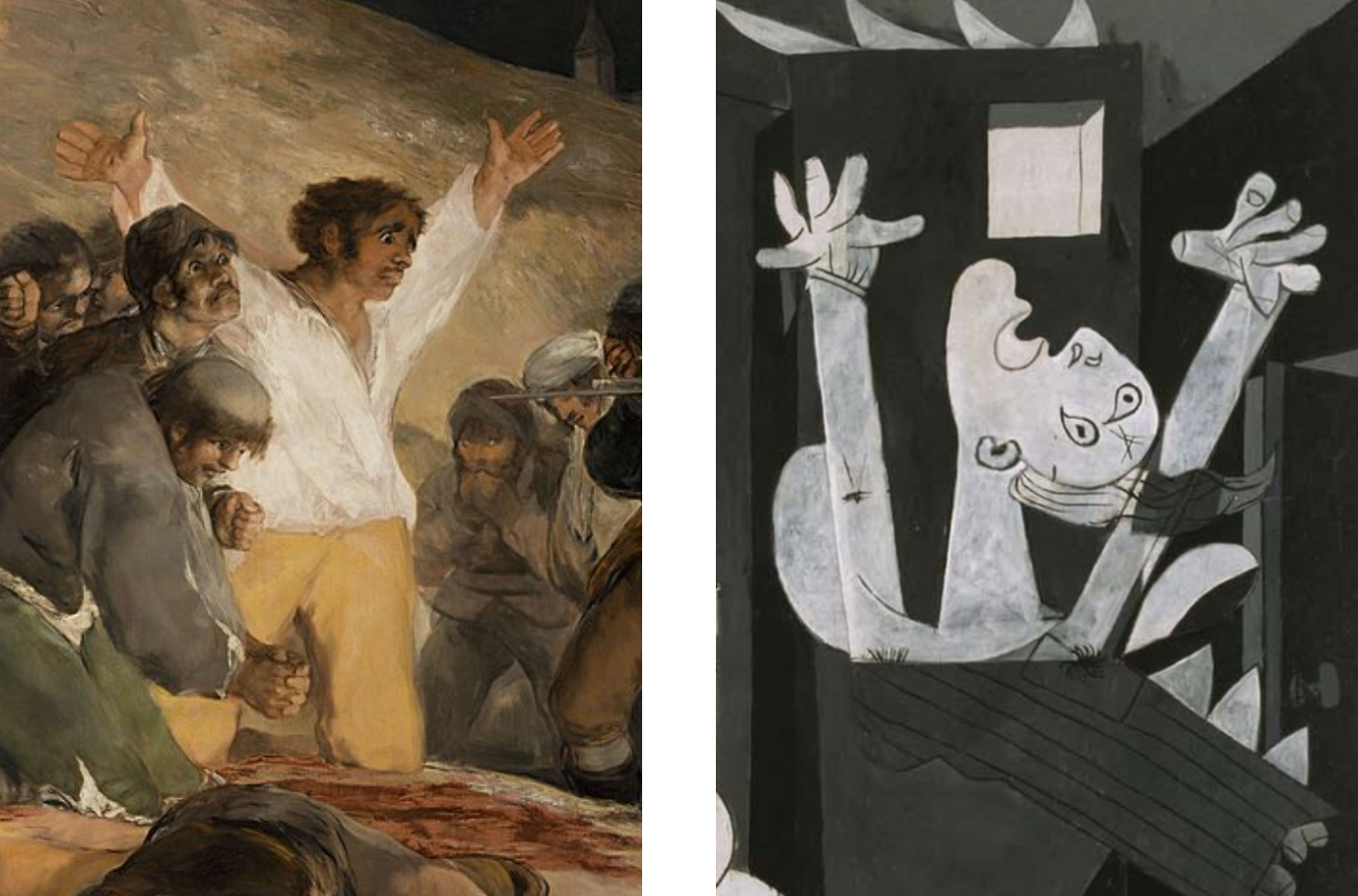
The painting itself is completely monochromatic, evoking the starkness of newspaper print, echoing how the world would have first encountered news of the bombing of the Basque village, even still, how Picasso himself would have received this information. Strikingly, the artwork contains no specific references that are symbolic of the true bombing, but instead, the artist has created an allegorical painting—a fictitious scene whose intensity encapsulates that wider devastation and loss of warfare. Herbert Read described the work as ‘a cry of outrage and horror amplified by a great genius’ (Carr, 2003). Here, there are several recurring motifs that are central to Goya’s works, as well as pertinent symbols of Spanish culture; critical in a period of such mass annihilation. The bull focused to the left of the canvas is highly symbolic within Spanish art, particularly emblematic of Goya’s La Tauromaquia series. Perhaps this a reflection of diminished cultural pride of a once vibrant national identity? The composition includes intentionally disparate, and fragmented elements that intensify the enforced sense of chaos, ‘omitting all but the realistic and heroic elements’ that warrant a societal reflection (Brunner, 2001). Likewise, positioned to the right, a woman with upraised hands is indicative of the principal figure in Third of May 1808 (see Figures 20 and 21), perhaps symbolic of the immediacy of death within both artworks. Both figures act as emotional anchors within their respective compositions. The stark shift from Goya’s upright, solitary martyr to Picasso’s disjointed, collapsing figure only reinforces the evolution of war itself — from intimate, direct executions to the impersonal and indiscriminate violence of mechanised warfare utilised today. Each artwork serves as a poignant reminder of the seemingly inevitable, redundant nature of war, and here, “Guernica blinds us, it stuns us […] we do not know where to look, where to direct our attention’ (Palau I Fabre, 1979). Here, art as suffering not only offers an essential critique of an isolated moment in history, but as recognition against contemporary acts of warfare, a forewarning for what could come to define modern warfare in the 21st century.
As previously discussed, Picasso’s Guernica has long been recognised as a universal symbol of anti-war sentiment, a documentary of the atrocities of conflict, and ultimately the devastating consequences of the human cost of war. The artwork’s iconic status has rendered it a focal point for both political controversy and suppression, as exemplified by the censorship of the work in February 2003 at the United Nations headquarters (Cohen, 2003). During a press conference held to justify military intervention in Iraq, a tapestry reproduction of Guernica (see Figure 22)—a permanent installation near the Security Council chamber—was deliberately obscured with a blue curtain overlay. This tapestry, commissioned by Nelson Rockefeller in 1955, and later gifted to the United Nations in 1985 (Dafoe, 2022), was principally intended to serve as a global symbol of peace; a blatant reminder of the horror implicit in warfare. Here, Mark Vallen stated that ‘Picasso’s antiwar masterwork would not make a very good backdrop for speeches advocating the bombing of Iraq’ (Walsh, 2003).
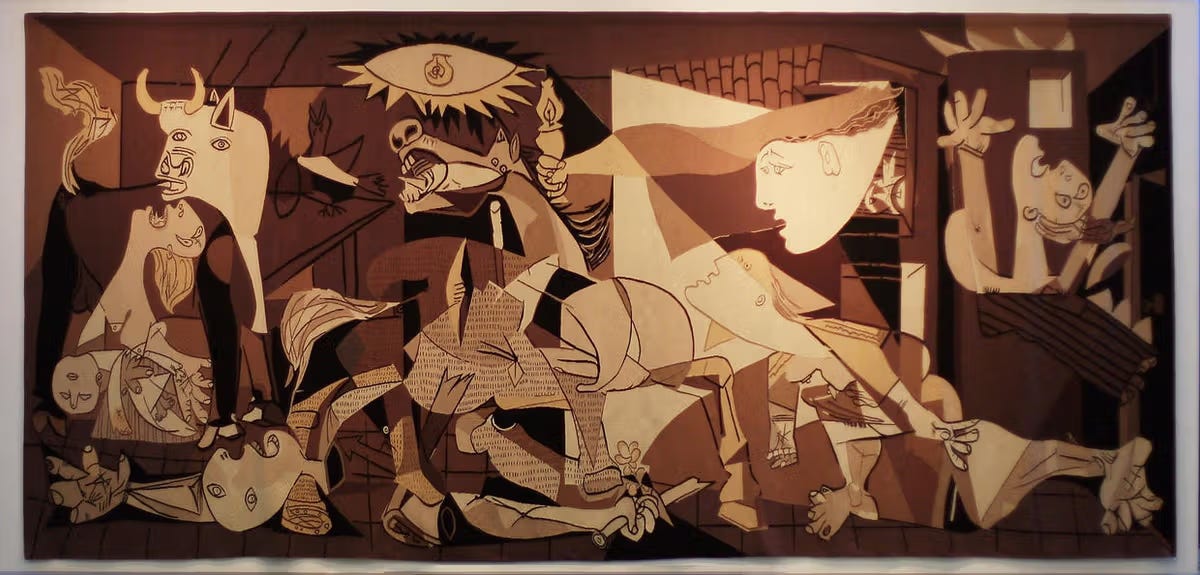
Despite this, its concealment during the 2003 press conference was highly emblematic of efforts to suppress the painting’s disruptive potential, standing in direct opposition to the rhetoric of war being presented. By concealing the artwork, officials effectively silenced its opportune critique of military aggression; entirely negating the so-desired peace that the work advocated for. This decision was broadly interpreted as an effort to neutralise its moral confrontation. Clark described Picasso’ contribution to the political art scene as an artwork that ‘opens the question of truth itself’ (1960), and its suppression only reinforced the discomfort of all-powerful institutions when promptly faced with art that challenges dominant narratives. How does the suppression shape a collective understanding of institutional accountability, and to what extent can art sustain its political impact when obscured?
The Old Verses The New
The enduring power of art lies solely within its ability to transcend temporal boundaries, to impose crucial insights that perhaps warrant further inquiry. Art historian Robert Hughs asserts the continued reverence for Goya, regarding him as ‘the two-hundred-year-old equivalent of the few photo images that leaked out of Vietnam’ (2003, 314). Just as Goya’s artistic genius captured the anguish of war-torn Spain, by comparison, topical photographs of Nick Ut’s Napalm Girl (see Figure 23) have become remarkable emblems of the moral failings of war, the moral failings that existed centuries in the past. Ultimately, the message remains the same. As human ‘nature’ has supposedly evolved, especially in modern history, technological and intellectual advancements are undeniable. From this wider outlook, art continues to prevail as a witness, although the notion of ‘art’ has dramatically transformed from the modest paintings and sketches of Goya. An apt statement attributed to Weiwei, ‘we are losing our humanity’ (Jones, 2019), in reference to the continual refugee crisis today. Mankind is actively losing its humanity. At least for Weiwei, the artist is celebrated for his multifaceted creative nature, justifying his work as ‘not a form but a philosophy of society’, (Pérez Art Museum Miami, 2013). Despite Weiwei’s multifaceted nature, a particular example of note, a documentary titled ‘Human Flow’ (Bradshaw, 2017) brings to light the ongoing global refugee crisis, in a world which has made such monumental strives of recent years. Spanning 23 countries, documenting - refugees fleeing from war-torn homelands, persecution and environmental collapse, the film piece emphasises the ineffable sufferings and resilience of those forced to migrate. Weiwei declares ’there is no refugee crisis, but only a human crisis […] we have lost our very basic values’ (Lunduis, 2020). The statement probes a pensive reflection, how is it that individual basic human requirements, safety and dignity remain unmet? While the medium of art continues to evolve, humanity’s ethical deficit remain constant.
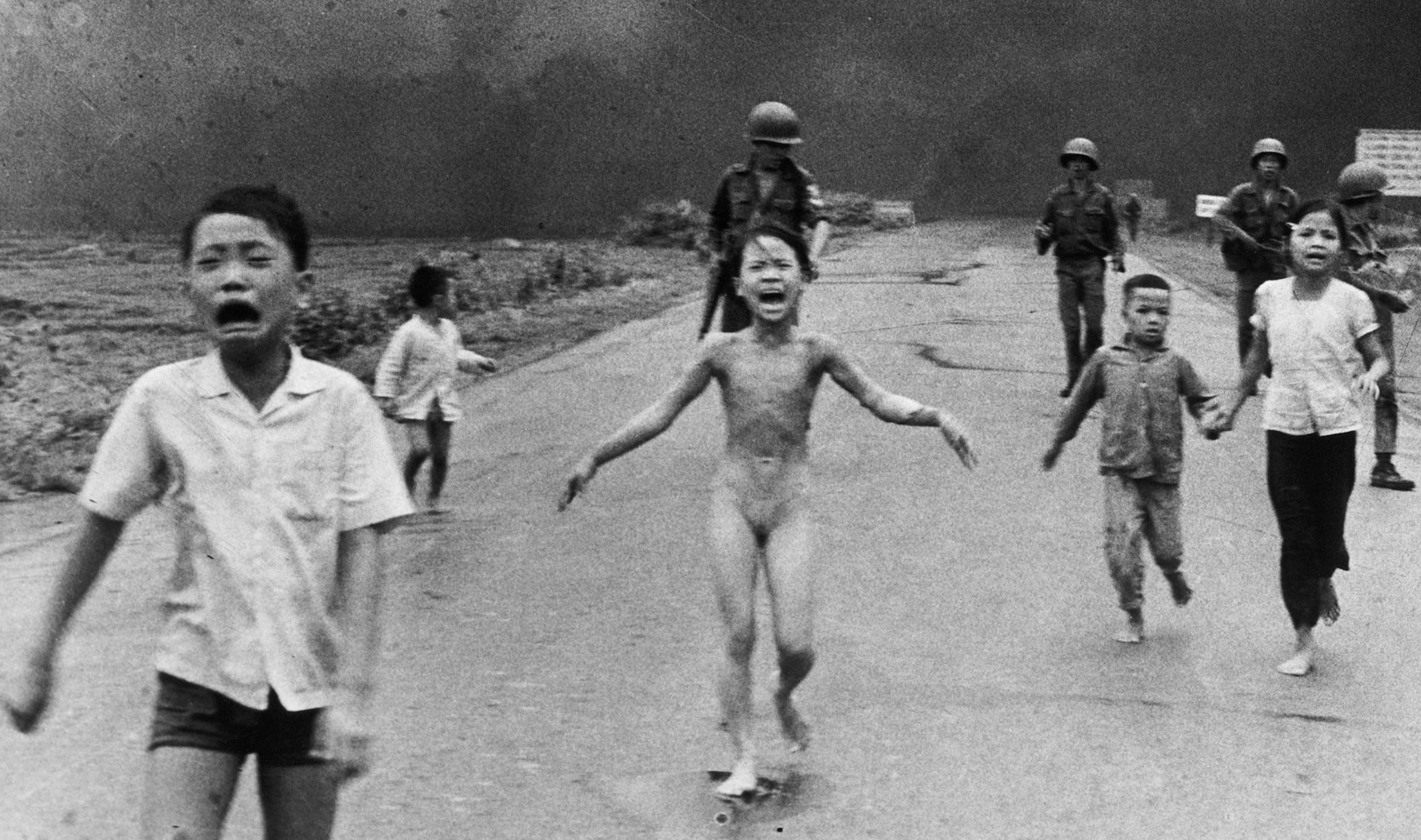
The advent of modernised technology has undoubtedly expanded global reach of such material. Digital platforms and media archives facilitate the accessibility of such historical works; a platform in which would simply unheard of centuries prior. This incites a critical question; does the widespread exposure of historical artwork resonate in a manner consistent with the intentions of its creator?
The cyclical nature of human history, seemingly stemmed from man’s inherent destructive behaviours raises critical questions surrounding a continuous inability to learn from the past. Philosopher and novelist George Santayana, as early as 1905, posits that, ‘those who cannot remember the past are condemned to repeat it’ (1905, 284). Despite such monumental advancements in alternate aspects of our human consciousness, humanity has consistently failed to translate such development into evolution. An ever-present cycle of ruin and devastation, suggests that deep-rooted, primal instincts of greed, fear, and tribalism remain fundamental components of our nature. Collective fear stimulates herd instinct’ (1943). Is fear the common driving force behind such instinctual behaviours? Is it so that these instincts prevent us from greater potential as a species? Greater still, do we even possess the capacity to learn from our own history? Art will always be fundamentally representative of our existing cultures and ideologies, perhaps art is an extension of our very being, but what does it truly mean to be human? An insatiable desire for the downfall of our opponents, a lust for slaughter and carnage becomes relentless; so relentless that will we ever be able to learn from ourselves? Truthfully, how far have we really come from our most primitive ancestors?
Conclusion
The question of moral progress extends far beyond the individual experience. If art, in its purest form, reflects human nature, it must highlight the paradox of our creative potential—both a vessel of expressive liberty and a reminder of our constraints. As outlined in this essay, Francisco Goya’s work embodies this duality, spanning themes of war, institutional corruption, and personal suffering, while exposing the unfiltered, unmonitored recesses of the human mind. His medium not only mirrors the darker facets of man, but also compels us to reflect upon our own humanity—how we, as individuals, process and respond to life. If art is implicit in human nature, then surely it becomes a universal symbol for life as we know it. As his art mirrors the ceaseless cycles of violence, oppression, and ruin, it forces us to ask—why do these patterns persist? Why, despite monumental advancements in technology, science, and culture, do we remain morally stagnant? Do we, as humans, lack the capacity to learn from our past, or is there a deeper, inherent resistance to confronting the uncomfortable truths about our very nature? If art is hardwired into the human experience, why has its power to provoke deep reflection failed to break these destructive patterns? Perhaps what is most troubling is the possibility that we recognise these patterns yet choose, consciously or unconsciously, to perpetuate them. In doing so we must ask, will we actively allow ourselves to repeat the atrocities of the past, or do we possess the righteous capacity to redirect the trajectory of human existence? Whether we choose to act upon these difficult truths—or continue to repeat the failings of our past—remains a choice yet to be made.
References
ALFORD, Roberta M. 1960. ‘Francisco Goya and the Intentions of the Artist.’ The Journal of Aesthetics and Art Criticism, 18(4). Wiley. [online].
ARN, Jackson. 2019. Francisco de Goya’s ‘Third of May’. Artsy. [online].
BAHR, Sarah. 2018. ‘Medical deafness or the madness of war: Goya’s motivation for creating the Black Paintings’ Hektoen International. [online].
Blind Dweller. 2021. ‘The Ominous Black Paintings of Francisco Goya.’ [documentary].
BRADSHAW, Peter. 2017. ‘Human Flow review – Ai Weiwei surveys shocking plight of migrants on the move’. The Guardian. [online].
BURNS-DANS, Elizabeth. 2018. ‘The shadow in the light: The dark romanticism of Francisco de Goya’ The University of Notre Dame Australia.
BUSH, Lawrence. 2015. ‘July 15: Innocent Declares Jews Guilty’ JewishCurrents [online].
BRUNNER, Kathleen. 2001. ‘‘Guernica’: The Apocalypse of Representation’, 143(1175), 80-85. The Burlington Magazine. [online].
CLARK, Kenneth. 1960. Looking at Pictures. Internet Archive. New York: Holt, Rinehart and Winston.
COHEN, David. 2003. ‘What’s so controversial about Picasso’s Guernica?’ Slate Magazine. [online].
CROSS, Emily S. and Kohinoor M. DARDA. 2022. ‘The role of expertise and culture in visual art appreciation’. Scientific Reports.
DAFOE, Taylor. 2022. ‘The Abrupt Removal of the U.N.’s 25-Foot Tapestry of Picasso’s ‘Guernica’ Caused an Uproar. Now, the Mystery Has Been Solved’. Artnet. [online].
DANCHEV, Alex. 2010. ‘Picasso’s politics’. The Guardian. [online].
DANTO, Arthur, C. 2023. FRANCISCO DE GOYA. Artforum. [online].
DAVIS, Heather A. 2004. Robert Hughes on Goya. Penn Today. [online].
DISSANAYAKE, Ellen. 1995. Homo Aestheticus: Where Art Comes From and Why. University of Washington Press. [online].
FESISATI, D. and SPERATI, G. 2010. ‘Francisco Goya and his illness’. National Library of Medicine. [online].
GARCIA, Ethan. 2023. The Importance of Art: Why We Need It. 1st Art Gallery. [online].
GARDNER, Howard. 1973. The Arts and Human Development. Wiley.
GENOCCHIO, Benjamin. 2008. ‘Social Commentary in Evocative Prints From Goya’ The New York Times [online].
GIES, David Thatcher. 1995. “GOYA, LIGHT AND DARK.” The Virginia Quarterly Review. 71(3), 560-65. [online].
GLENDINNING, Nigel. 1975. ‘The Strange Translation of Goya’s ‘Black Paintings’,
Great Art Explained. 2023. ‘Dark Goya (Full length): The later Works’. [YouTube user-generated content].
Great Art Explained. 2020. ‘Picasso’s Guernica: Great Art Explained’. [YouTube user-generated content].
HAGEN, Rose-Marie and Rainer HAGEN. 2005. Goya: 1746-1828. Taschen. [e-book].
HARVARD UNIVERSITY PRESS. 1932. Aristotle (ca. 350 BCE). Translated by W.H. Fyfe. Aristotle in 23 Volumes, (23). William Heinemann Ltd.
HEGEL, G.W.F. 1997. On Art, Religion, and the History of Philosophy. Hackett Publishing Company.
HICKMAN, Richard. 2005. ‘Why We Make Art: And Why it is Taught’ Intellect Books. [e-book].
HONOUR, Hugh and John FLEMING. 1984. A World History of Art. 7th edn. Laurence King Publishing.
HUGHS, Robert. 2003. Goya. The Harvill Press.
JONES, Dylan. 2019. ‘Ai Weiwei: ‘It’s not a free world, even in the US or Europe’. British GC. [online].
LIVELY, Jack. 1981. ‘The europe of the enlightenment’. History of European Ideas, 1(2), 91-102. [online].
LUBOW, Arthur. 2003. ‘The Secret of the Black Paintings’ The New York Times. [online].
LUNDIUS, Jan. (2020). ‘Globalization of Indifference: Ai Weiwei and the Refugee Crisis.’ Global Issues. [online].
Master’s Gaze. 2023. ‘All the Art Movements that Shaped our World’. [YouTube user-generated content].
MEYER, Isabella. 2020. ‘Art Periods – A Detailed Look at the Art History Timeline’. Art in Context. [online].
MEYERS, Jeffrey. 2022. ‘Goya and Picasso: humanity and horror’. TheArticle. [online].
PALAU I FABRE, Josep. 1979. El Guernica de Picasso. Blume [e-book].
Pérez Art Museum Miami. 2013. ‘Ai Weiwei: According to What?’ [online].
Perspective, 2023. ‘Goya: The Romantic Pioneer Whose Paintings Took A Dark Turn’ [video clip].
PHELAN, Stephen. 2019. ‘Goya’s Black Paintings: ‘Some people can hardly even look at them’. The Guardian. [online].
PINKER, Steven. 2018. How the Enlightenment Gave Us Peace, Prosperity, and Progress. Cato Institute. [online].
RAWLINGS, Helen E. 2012. ‘Goya’s Inquisition : From Black Legend to Liberal Legend’.
RAYMOND, Carr. 2003. The triumph of outrage. The Spectator. [online].
RICH, Alexander H. 2018. ‘Masters of Spain: Goya and Picasso’ Polk Museum of Art. [online].
ROBINSON, Lynn. 2015. ‘Pablo Picasso, Guernica’. Smarthistory. [online].
ROSE, Clifford F. 2006. The Deafness of Goya (1746–1828). ScienceDirect. [online].
RUSSELL, Bertrand. 1943. Passages from An Outline of Intellectual Rubbish. Kent State University. [online].
SANTAYANA, George. 1905. The life of reason: Vol 1: Reason in common sense. Charles Scribner’s Sons. [online].
SAX, Lyla. 2020. ‘Depictions of the Korean War: Picasso to North Korean
Propaganda’ The Macksey Journal. [online].
SYMMONS, Sarah. 1998. Goya. Phaidon Press Limited.
TED-Ed. 2014. ‘A brief history of religion in art - TED-Ed’. [YouTube user-generated content].
THE ARTIST EDITORIAL. 2023. ‘Why You Must Know Goya’s Black Paintings, The Darkest Painting Series in the World’. artist. [online].
TOMLINSON, Brittany. 2021. ‘Why are these paintings so scary?’ [YouTube user-generated content].
TURNER, Mark. (ed.) 2006. The Artful Mind: Cognitive Science and the Riddle of Human Creativity. Oxford University Press. [e-book].
WALSH, David. 2003. ‘UN conceals Picasso’s “Guernica” for Powell’s presentation’. World Socialist Web Site. [online].
WILLIAMS, Gwyn A. 1976. Goya and the impossible revolution. Peregrine Books.
ZAPPELLA, Christine. 2017. A-Level: Francisco Goya, The Third of May, 1808. Smarthistory. [online].